Lieutenant-Colonel G. Hedley Basher
Royal Regiment of Canada
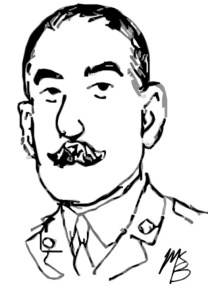
[Courage] it’s something you’ve got or you have not got, but often good leadership will overcome the slightest sign of weakness among men. On the other hand, of course, cowardice on the part of one man is liable to spread its evil through the whole group. You won’t hear anything about cowardice from our lads. They can take it. I’ve looked them over and I know.
(Basher, Toronto Star, 25 Oct 1939, 11)
Born in Cornwall, England on 28 December 1891, George Hedley Basher was a Toronto police officer and governor of the notorious Don Jail from 1919 to 1931. Having immigrated to Canada in 1913, he joined the 3rd Battalion (Queen’s Own Rifles) the next year and received a commission in the British Army by early 1915. He served with the Duke of Cornwall’s Light Infantry in Egypt and Salonika, and with the King’s Own Yorkshire Light Infantry at the Somme. The 24-year-old major was then appointed governor of a military prison in England and by the end of the war headed all British military prisons in the field.
On return to Canada in 1919, he continued his prison governor duties in a civilian capacity. At the Don Jail he adopted a strict disciplinary regime and advocated corporal punishment. The strap, he argued, was one of the more effective reform instruments. Following a 1931 prison riot in which Basher ordered several young ringleaders strapped, he was moved to a new position as superintendent of a prison farm.
With the outbreak of the Second World War, Basher returned to active military duty as commanding officer of the Royal Regiment of Canada. After deployments to Iceland and England, he was replaced by Major D.E. Catto in July 1942, less than a month before the fateful Dieppe Raid. Lieutenant-Colonel G.M. MacLachlan of the Royal Hamilton Light Infantry recalled of his leadership:
Colonel Basher earned the esteem and respect of almost all who served and trained under him. His enforcement of strict discipline became a tradition in the regiment and because he was always fair and impartial, even those who “suffered” often in his orderly rooms were known to have boasted about having the toughest, but fairest, CO in the Canadian Army.
Afterward, in battle, many a man thanked his lucky stars that he had learned discipline and soldiering under Basher. Majors were known to tremble more than buck privates when waiting to answer for some indiscretion. Everyone in the Regiment knew that the ‘old man’ would fight their just battles to the highest authorities, when necessary, and that he never issued an order which he was not prepared to carry out himself.
Basher commanded a reinforcement unit in North Africa and Italy before his return home in August 1944. “Some of the SS troops which opposed the Canadians at the Hitler and Gustav Lines were just about as crack troops as you’ll find anywhere,” he told the press. “But the Canadians cracked them.”
He was superintendent for the Guelph Reformatory from 1946 until his appointment to be Ontario deputy minister of reform institutions in 1952. High-profile prison riots in addition to his harsh disciplinary methods and opposition to progressive reforms led to his retirement in 1959.
He died in Whitby, Ontario on 9 October 1960.
 World War Graphic History