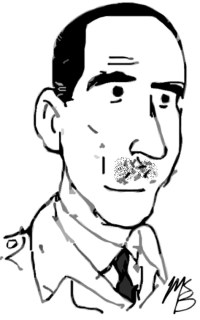
Lieutenant-Colonel M.B.K. Gordon
27th Armoured (Sherbrooke Fusilier) Regiment
I had meant to speak to all of you before leaving but time would not permit. We have known joy end sorrow together which I feel and hope has welded us together so tightly that no matter what the lapse of time, nothing can destroy that feeling of wonderful teem spirit we have developed. Each and every one of you has been magnificent in his job, Your loyalty end will to get on has been more then anyone could ask
(Gordon farewell address, war diary, 7 Feb 1945)
Born on 7 September 1905 in Dixie, Ontario, Melville Burgoyne Kennedy Gordon was a Quebec lawyer and graduate of the University of Toronto, where he had belonged to the Canadian Officers’ Training Corps. Commissioned with the Governor General’s Body Guard in 1924, he transferred to the Princess Louise Dragoon Guards in 1928, rising to the rank of major. He mobilized for active service in May 1941 with the 12th Armoured (Three Rivers) Regiment. In February 1943, he was promoted to command the 27th Armoured (Sherbrooke Fusilier) Regiment.
Eighteen months later, the Sherbrookes embarked for the invasion of Normandy on 6 June 1944. Following the initial landings on D-Day, the 27th CAR went ashore at Juno Beach. After much hard fighting over the next several weeks around Caen, on 9 July, Gordon’s scout car was the first to enter the city to see if it was safe for the tanks. He earned the D.S.O. for “outstanding qualities of leadership throughout the action and was to a great extent directly responsible for the success of this most important operation. His action required him, on many occasions, to move in the most fwd areas.”
After seven months in command in the field, Gordon was relieved in early February and posted to No. 1 Canadian Armoured Corps Reinforcement Unit in England. “And now I must say good-bye to you,” he stated in his farewell address. “I do it knowing full well that you will carry on the fighting spirit of the Regiment end bring more honour and glory to it. You—each one of you—my friends. God Bless all of you end good luck to you. May the time come soon when I will be seeing all of you again.” Lieutenant-Colonel Fred Jenner, former general staff officer with the Canadian Armoured Corps, arrived as the new commanding officer.
As a trained lawyer, Gordon also served as court president for many courts martial as the war ended. Three of the most notable cases in which he presided involved the treason trials of Privates George Hale, John Galaher and E.B. Martin of the Essex Scottish in August 1945. Captured at Dieppe three years earlier, the trio had joined the British Free Corps and were convicted of aiding the enemy.
Gordon resumed his civilian law career in Ontario after the war and died in Ottawa on 7 October 1974.
 World War Graphic History