Lieutenant-Colonel Frank White
6th Armoured (1st Hussars) Regiment
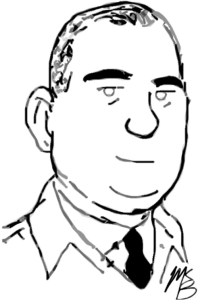
When he landed on the beach on D-day between Courseulles-sur-Mer and Bernières-sur-Mer no exits had been completed and the beach was under heavy enemy mortar and machine gun fire and traffic was piling up. He got out of his tank and walked calmly up and down the beach endeavouring to find an exit. His example of complete coolness at that critical time was an inspiration to the officers and men of the regiment. His actions since D-day have continued to be outstanding to the highest degree.
(D.S.O. citation, 19 Apr 1945)
Born on 24 May 1909 in St-Faustin, Quebec, Franklyn Everhart White was the son of General John Burton White, head of the Canadian Forestry Corps. In the last war the elder White had commanded the 242nd Battalion and then served as Director of Timber Operations in the Canadian Forestry Corps. Following his father’s military service, Frank White graduated from RMC and joined the Permanent Force, taking a commission with the Lord Strathcona’s Horse in Winnipeg.
By January 1944, White had risen to become second-in-command of the 6th Armoured (1st Hussars) Regiment under the command of R.J. Colwell, who himself had come from the Halifax Rifles. On D-Day, White led the Hussar Tanks squadrons ashore in support of the 3rd Canadian Division landings at Juno Beach. His leadership that day earned him the Distinguished Service Order:
Major White was considerably responsible for the success of his regiment in the assault on France due to his untiring efforts prior to the invasion. The regiment was assaulting with DD tanks, a new and hazardous type of weapon. Without regard to his own personal safety he carried out experiments with these tanks which subsequently decreased their risk and undoubtedly saved the lives of many who used them.
He earned further praise during the hard fighting attempting to close the Falaise Gap in mid-August: “With complete disregard for his own safety, in close country swarming with enemy infantry and Anti-tank guns, he reconnoitered a route and proceeded across the river alone … This successful attack enabled the supporting infantry to move forward to the objective with very light casualties. His fine consistent display of coolness, courage and fighting spirit is worthy of the highest recognition.”
White succeeded Colwell in command before the end of August 1944. He led the Hussars until the end of the war, provided invaluable armour support to Canadian and British infantry. “All ranks, without exception, were loud in their praises of your chaps and it is our opinion that we have never been so well supported,” Brigadier J.A. Roberts of 8th Canadian Infantry Brigade wrote to White. “Casualties were heavy both in the brigade and in your regiment but we have the satisfaction of knowing that that task was successfully completed and that not only was valuable experience gained, but that added confidence was imbued in our two arms of the service in one another.”
On news that his father had died on 31 May 1945, White relinquished command to Major W.D. Brooks in order to fly home to Canada. After the war, he commanded the Lord Strathcona’s Horse after the war and attended staff college in India. In 1950, he was selected as a United Nations observer in the early phase of the Korean War.
White died in Ottawa on 4 April 1954.
 World War Graphic History