Lieutenant-Colonel Bill Darling
4th Princess Louise Dragoon Guards
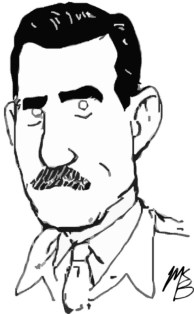
Little can be said about the C.O. that would do justice to a great leader, a wonderful Colonel. Certainly his departure leaves a gaping wound in our hearts, that nothing can ever heal. The C.O. had been with this Regt ever since its conception, and had come up through the various ranks until he became the Commanding Officer, and led this Regiment in all of its battles as an Infantry Unit.
(PLDG war diary, 8 Dec 1944)
Born on 19 April 1906 in Toronto, Warren William Gibson Darling was the son of the former commanding officer of the 48th Highlanders and joined the regiment himself in 1929. He went overseas in December 1939 and participated in the regiment’s short-lived deployment to France in June 1940. Darling helped to commandeer the French train which allowed the Canadians to escape German encirclement and return back to England.
In 1941, he transferred to the newly formed 4th Reconnaissance Battalion (Princess Louise Dragoon Guards). The PLDG squadrons served as part of the 1st Division in the Italian theatre from summer 1943 to spring 1944. Throughout this period Darling acted as second-in-command to Lieutenant-Colonel F.D. Adams.
In July 1944, Allied military leaders decided that the 5th Armoured Division required additional infantry regiments for the newly formed 12th Infantry Brigade. The 4th Reconnaissance Battalion left the 1st Division and converted to the PLDG infantry regiment. Service as infantrymen came as an unwelcome transition to many PLDG officers and troopers causing unit morale to suffer. The war diary captured this feeling noting that some men set off flares and “much vino consumed in an effort to neutralize the pains of frustration, despair and complete loss of morale.”
Shortly after the announcement, on 12 August, Adams relinquished command to Darling, who worked to improve the unit’s morale situation. He remained with in command of Princess Louise Dragoon Guards until the end of the year.
He earned the Distinguished Service Order for leadership during the battalion’s attack against the Gothic Line on 1 September 1944: “The battalion, made. up largely of inexperienced troops and, with officers recently converted from a reconnaissance regiment who were now fighting their first infantry action, became rather disorganized … Being the outstanding figure in the attack, he was made the subject of special attention by snipers and machine-gunners. In the final assault, Lieutenant Colonel Darling personally led remnants of two companies, some fifteen all ranks, on to the objective.”
Relieved of command on 8 December 1944, Darling expressed a reluctant farewell to the PLDG:
In leaving the Regt I do so with a very heavy heart. I am leaving the finest Regt by any standards in the army to-day. You have never failed me, have never failed to get your objective, and have won a wonderful name for yourselves by your guts and determination. It has been my proudest privilege to have commanded this Regt.
After the war, Darling returned to the 48th Highlanders, serving as commanding officer from 1946 to 1949. He was honorary colonel and then honorary lieutenant-colonel of the regiment during the 1970s.
He died in Toronto on 25 June 1979.
 World War Graphic History