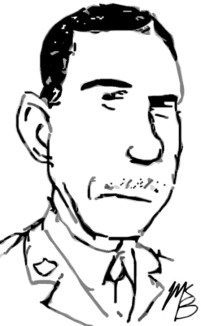
Lieutenant-Colonel Bill Buchanan
Lanark and Renfrew Scottish
Give them our best wishes and tell them that this famous old Regiment has been revived again in a new blaze of glory and every time we look at the new shoulder flash we will think of the wonderful example of courage they showed. Everybody has heard of the Lanark and Renfrews now and are greatly interested in the new flash because of the way the boys put it right on the map of the world again.”
(Buchanan quoted by Padre C.M. MacLean, 15 Jan 1945)
In July 1944, Allied military leaders in Italy had decided to add a new infantry brigade to the 5th Armoured Division in addition to the 11th Infantry Brigade. The 1st Canadian Light Anti-Aircraft Regiment converted from artillery to infantry as part of the newly formed 12th Infantry Brigade under Major-General Dan Spry. At the end of August 1944, Major William Herbert Buchanan transferred from the Seaforth Highlanders to become second-in-command to Lieutenant-Colonel W.C. Dick, the officer assigned to reorganize the anti-aircraft unit. Born on 5 August 1913 in Medicine Hat, Alberta, Buchanan was a fireman who had originally joined the Calgary Highlanders.
When Dick was appointed general staff officer for the 5th Division in September 1944, Buchanan assumed command of the yet unnamed unit. Since its conversion to an infantry unit, the 1st Light Anti-Aircraft Battalion had yet to receive a proper regimental title. It had used an improvised designation 89/109 Infantry Battalion in reference to two dissolved light anti-aircraft batteries. As most officers wished to be associated with a highland regiment, it had been proposed some months before that the unit be named either 2nd Battalion, 48th Highlanders or the Lanark and Renfrew Scottish, an Ontario militia regiment not mobilized for active service.
It took until November for higher authorities to finally approve a distinctive regimental identity. After the official re-designation of the 89/109 Battalion to the Lanark and Renfrew Scottish, the war diary observed, “This was especially pleasing to the easterners and all felt that it was much better to have a name than two numbers.”
Buchanan served as commanding officer for the remainder of the Italian campaign. When I Canadian Corps transferred to Northwest Europe in March 1945, the 12th Brigade was disbanded and the Lanark and Renfrew Scottish reverted to 1st Canadian LAA Regiment as part of the Royal Canadian Artillery. The war diary recorded the news that the unit was to disappear “came as a severe blow to everyone in the regiment who has fought and worked so hard to make his in a very short time a first class fighting unit ready to fight against the most severe opposition.” On 14 March, Buchanan handed command over to Lieutenant-Colonel G.C. Howitt.
Buchanan commanded the Regina Rifles as part of the Allied occupation force in Germany and in 1949 became commanding officer of the South Alberta Regiment. At the height of Cold War tensions, he declared in 1950, “I cannot see how war with Soviet Russia can be avoided within the year.” (Calgary Herald, 8 May 1950, 9)
Buchanan died on 23 April 1971 in Oakville, Ontario.
 World War Graphic History