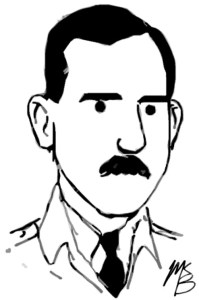
Lieutenant-Colonel Jim McAvity
2nd Armoured Regiment (Lord Strathcona’s Horse)
Throughout these operations and previously in the Italian theatre throughout the breaking of the Gothic Line in August 1944, the crossing of the River Conca, up to Coriano Ridge and the battles of the Po Plain the outstanding ability, enthusiasm and drive of this officer was undoubtedly of very great bearing on the successful completion of these operations.
(D.S.O. citation, 8 May 1945)
Born on 20 November 1909 in Montreal, James Malcolm McAvity was a tennis player and businessman. A graduate of RMC in 1931, he joined the army in 1940 and was one of a dozen officers to attend tank tactics training in England. He personally bought 18,000 acres of land for the Meaford tank range near Camp Borden. He went overseas with the Halifax Rifles in June 1943 and transferred to the Lord Strathcona’s Horse in August.
Designated the 2nd Armoured Regiment, the LdSH departed for Italy in November 1943. McAvity served as a squadron commander, became second-in-command after the battle at Melfa River on 24 May 1944, and succeeded Griffin just over a month later. As the war diary noted, “July of 1944 binds two important regimes—the old, enriched by the brilliant and hard work of Lt-Col P.G. Griffin, DSO, and the new—a bond to the future activities and successes under the leadership of Lt-Col. J.M. McAvity.”
He remained in for the rest of Italian campaign through to the final offensive in Northwest Europe. For his “clever planning” for a night attack on German anti-tank guns on 16 April 1945, he earned the Distinguished Service Order. A veteran remembered: “He was a good Commanding Officer. He let we Sqn Commanders get on with the job of training and fighting our squadrons, asking only that we did it effectively and efficiently.”
While awaiting repatriation after V-E Day, he wrote a chronicle of the regiment’s wartime service, published in 1947 as Lord Strathcona’s Horse (Royal Canadians): A Record Of Achievement. On demobilization, McAvity resumed a successful business career and founded the Canadian Export Association in 1963. He was active in gold, tennis and curling clubs and was known as “Mr. Tennis” for his advocacy of his favourite sport.
He succeeded Brigadier F.M.W. Harvey as Honorary Colonel of the Lord Strathcona’s Horse from 1966 Mar 1971. He retired to Brockville, Ontario where he died on 14 April 2002.
 World War Graphic History