Lieutenant-Colonel Pat Grffin
2nd Armoured Regiment (Lord Strathcona’s Horse)
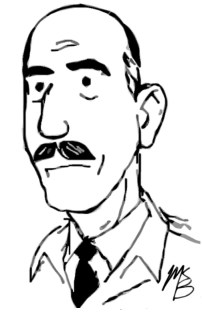
Many orders may mean the sacrifice of life to gain an ultimate important objective such orders will not be given by the comd without a great deal of consideration and when given they must be obey instantly and implicitly.
(P.G. Griffin, LdSH War Diary, 28 Apr 1944)
Born in County Down, Ireland, on 8 March 1893, Philip (Patrick) George Griffin was an advertising manager in Toronto and a First World War veteran. He had joined the Royal Canadian Dragoons in 1913 and earned a commission with the Canadian Machine Gun Brigade at Vimy Ridge. He served the Lord Strathcona’s Horse until retirement in 1929 for health reasons. Ten years later he joined his old regiment as a captain and went overseas as second-in-command in November 1941.
He assumed command of the now redesignated 2nd Armoured Regiment from Lieutenant-Colonel N.A. Gianelli in October 1942. He led the Lord Strathcona Tanks to Italy as part of the 5th Armoured Brigade, 5th Canadian Armoured Division in December 1943. He became one of the very few First World War veterans to command a Canadian battalion in action during the Second World War. This war was also a family affair. One son served as a trooper with the Princess Louise Dragoon Guards while his other son flew with the Royal Air Force. His brother, Frederick Griffin, worked as war correspondent for the Toronto Star.
Noting a degree in slackness and grousing, Griffin distributed a memo to the LdSH at the end of April 1944 reminding officers and NCOs of the importance of following orders. Citing an incident from the last war, Griffin explained that a “sacrifice force” had needed to draw enemy fire from the main assault. “The troop was wiped out, the order had been obeyed without question, the operation was successful.” He called on his subordinates to live by the motto, “Do it now, do it well and demand immediate unquestioned obedience of all orders given.”
A month later on 24 May 1944, the regiment put this motto to the test at Melfa River. Supporting the Westminster Regiment’s advance, Griffin’s tanks encountered a larger number of enemy Panther tanks. Outgunned, the Lord Strathconas suffered heavy losses in men and armour but inflicted equally heavy casualties on the Germans. One Westminster officer called Griffin “every inch a soldier and truly a ‘man’s man.’” Although wounded by shrapnel in the face and arm, he remained on duty and received the Distinguished Service Order:
Although his tank was hit twice, Lieutenant Colonel Griffin continued to fight with his Regiment which suffered heavy casualties, in order to reach the objective.
Throughout this action, Lieutenant-Colonel Griffin demonstrated outstanding and exceptional powers of leadership. In the face of all hardships and difficulties he attained his objective.
In July 1944, Griffin handed command over to Major J.M. McAvity. “I have been privileged far beyond my wildest dreams in being permitted to fight [with] the Regiment I trained and saw develop under my supervision,” he announced in his farewell address. “Few, if any Canadian soldiers of the last war, have been so privileged, and I consider it a great honour.” Partly in jest he reminded all officers, NCOs, and men:
It is a profound heritage you accept when you first put up our badge, and I look to you never to bring discredit on that name by any actions on your part. If you do, you may rest assured the ghosts of past Strathcona’s will haunt you into eternity—and that is a horrible curses, ‘case there have been some awful tough Strathcona’s.
Medically unfit for active service, he returned to Canada in September 1944 with a promotion to colonel attached to No. 2 Military District (Toronto). Concerned about his future following relief from combat command, Griffin had stressed to militia authorities:
I have now given approximately 21 years, the best years of my life, to the service of my country and spent approximately 10 of my last 30 at warm and as I find it difficult to re-establish myself in civil life … I feel I could be of value to the Department of National Defence in a job pertaining to either training, armour, demobilization, etc.
(P.G. Griffin, service file, 28 Jun 1944)
He was struck off strength in October 1945 and admitted to hospital with severe stomach problems. He died on 17 November 1945 from complications of post gastrectomy.
 World War Graphic History