Lieutenant-Colonel Boyd Somerville
Cape Breton Highlanders
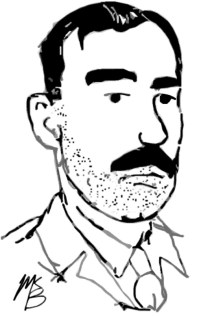
It was a joy to work under Boyd, and it didn’t matter to him if I was “under command” or “in support.” As an old soldier you can appreciate the difference. He never, ever gave me a direct order; it was always, “Tim, what can you do for me?” when he needed help.
(Tim Ellis quoted in Alex Morrison, The Breed of Manly Men, 213)
Born in Montreal on 19 June 1910, Robert Boyd Somerville was the long-serving second-in-command of the Cape Breton Highlanders (CBH) in England and Italy. The troops nicknamed him Pete the after the unshaven cartoon character “hobo with a gentleman’s instincts.” A former stockbroker and businessman, Somerville went overseas on active service with the Royal Highlanders of Canada before being transferred to the CBH under the command of fellow Black Watch officer Lieutenant-Colonel Jim Weir.
Although the original Cape Breton volunteers had resented the arrival of senior officers from another regiment, they soon developed an affection for Somerville, who impressed the men with his confident and casual manner. The protest against the new leadership culminated in a “sit-down strike” on 11 May 1942 when the battalion refused to go on parade. CBH veteran Fred Cederberg remembered one long route march as ending the conflict between the Montreal Highlander officers and the Nova Scotia Highlander troops: “Colonel Weir and 2/I-C Major Sommerville walked with the men, striding out singing along, tirelessly. In fact Sommerville, whose battle-dress trousers were slightly too large for his ass, was tagged Pete the Tramp for the way he walked despite blisters.”
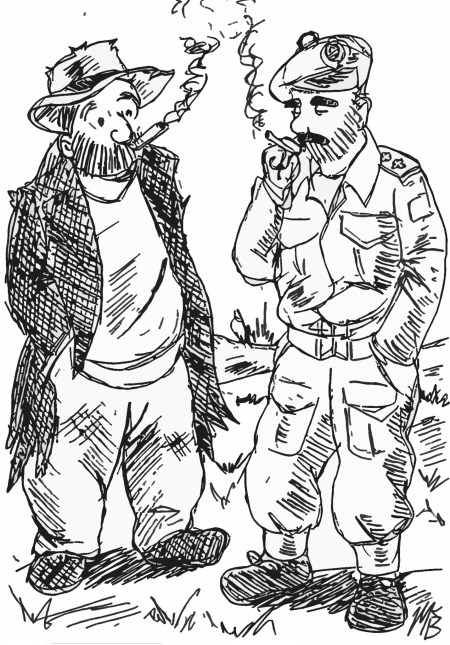
Pete the Tramp and Boyd the Colonel
Following his promotion to major in May 1942, Somerville served as second-in-command for over two years. The regiment arrived in the Italian theatre as part of the 11th Infantry Brigade in November 1943 and went into battle the following January. After recovering from high casualties in this first action, the regiment settled in for the hard frontline winter conditions.
By April 1944, the Highlanders marked the two-year anniversary of Weir and Somerville taking over. Referring to the early difficulties with the original troops, the second-in-command stated: “The CO and I are proud of our unit both in England and in Italy and although there have been many a bump and man a ‘tiff’ during the time we have worked together, this is an anniversary of which we are justly proud.”
One month later, feeling that the battalion required new and more aggressive leadership, Brigadier Eric Snow of the 11th Brigade rested Weir in favour of Somerville during the Liri Valley offensive. Although Weir officially remained in command for a few more months, he was finally relieved in August. Promoted to lieutenant-colonel, Somerville would lead the Highlanders for the rest of the war through the Italian campaign and into Northwest Europe.
Command of the CBH passed to Major Syl McKinnon a month after V-E Day when Somerville became acting commander of the 11th Infantry Brigade. He earned the Distinguished Service Order for his ten-month tenure of command of the CBH:
The Cape Breton Highlanders has distinguished itself and gained further honours to add to its already imposing list. In this connection the outstanding qualities of leadership, bravery under fire, skills in action, prodigious and ardent devotion to duty of Lieutenant-Colonel Somerville have resulted in an outstanding performance by the battalion.
Following a successful business career, Somerville died in Toronto 18 July 1983.
 World War Graphic History