Lieutenant-Colonel Jim Weir
Cape Breton Highlanders
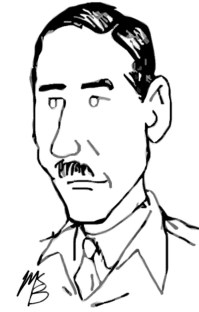
“There are, however, places where a man can get fixed up,” the colonel went on, “legitimate places. And those of you who have disobeyed regs, know what I’m referring to–whorehouses, old fashioned whorehouses. Which leads to why you’ve been kept out of the towns. There’s a lot of old-fashioned VD around and the army is trying to make sure all of you don’t get dosed. I know, some of you will. But don’t say I didn’t warn you.”
(Quoted in Fred Cederberg, The Long Road Home, 70)
Born in Montreal on 10 April 1906, James Buchanan Weir was a stockbroker and member of the Royal Highlanders of Canada (The Black Watch) since 1926. He resigned as vice president of the Canadian Commodity Exchange in November 1939 to enlist for active service and went overseas as a major. In the United Kingdom, he was one of several Black Watch officers transferred to the Cape Breton Highlanders (CBH). Despite their shared highlander traditions, the Nova Scotia battalion did not view the Montreal replacements at all favourably.
In April 1942, Weir arrived to the CBH, succeeding another Black Watch officer who had temporarily replaced Lieutenant-Colonel E.H. Small, an original militia officer and veteran of the 85th Battalion in the First World War. The arrival of more and more Black Watch officers, including second-in-command Major R.B. Somerville and Captain J. Aird Nesbitt, provoked growing resentment among the original Cape Breton volunteers. The morale problem culminated in a “sit-down strike” on 11 May 1942 when the battalion refused to go on parade.
After the invention of higher-ups, the soldiers accepted the new senior officers as a military necessity which did not reflect negatively on the abilities of the storied regiment. Although many came to respect Weir as their CO, his hard approach and short temper meant he was never embraced by either ordinary soldiers or junior officers. Following a year-and-a-half of training and exercises, the regiment deployed to Italy as part of the 11th Infantry Brigade, 5th Armoured Division in November 1943.
According to CBH veteran Fred Cederberg in his 1985 autobiography, Weir delivered a colourful and frank speech on arrival in what he called the “Eyetieland” theatre: “The Eyeties are now officially considered our allies … Well, I’m telling you this: As far as I’m concerned, they just defeated enemies and you can treat ’em as such!” On the threat of vice and venereal disease, he explained, “I know you men better than you think I do. You’ll get drunk and want to find some pussy. That’s life. But for God’s sake, and the sake of your wives and girlfriends, use the safes, the prophylactics, the Canadian taxpayers offer you free!” He ended on a more somber note, reminding the men, “remember there is a purpose behind everything you’re asked to do. It’ll save lives in the long haul.”
Cederberg described the brigade’s first action on 17 January 1944 as a fiasco. He recalled the colonel unbraiding the men in the aftermath: “It was a damned poor show! … Like scared goddamned rabbits, you bolted out of that valley! With your tails between your legs!” But Cederberg added he overheard Weir privately admit: “What the hell did the army expect? Green boys going against crack paratroopers!”
On the two-year anniversary of Weir taking command, the battalion war diary commented in April 1944:
To command an infantry battalion so well and for so long a time is indeed an unusual occurrence. Lieutenant-Colonel Weir took command of the unit and with firm discipline and hard training has made it into an efficient and capable fighting machine, a unit of which he is proud and of which all officers and men are proud.
Respected but never loved by the men, Weir served another three months in command before being replaced by second-in-command Major Boyd Somerville in August 1944. In a confidential change of employment report, Brigadier I.S. Johnston of 11th Infantry Brigade noted Weir “has commanded the CBH in and out of action for a period of over two years with great energy and enthusiasm. The strain of this comd has had such an effect on Lt-Col Weir’s mental and physical condition that he now requires a good rest.” Weir strenuously protested that “the physical and mental strain of commanding had not affected me in any way and had nothing whatever to do with the case.” He insisted that he had agreed to be relieved only to give his second-in-command a promotion and had no desire for an administrative posting.
Promoted to colonel, Weir commanded a training brigade in England and a brigade during the occupation of Germany. He retired as a brigadier in the reserve army in 1952.
Having resumed his stockbroker career in civil life, Weir served as chairman of the Canadian Stock Exchange from 1950 to 1952 and the Montreal Stock Exchange from 1953 to 1957.
He died in Montreal on 13 May 1974.
 World War Graphic History