Lieutenant-Colonel Leige Payne
Irish Regiment of Canada
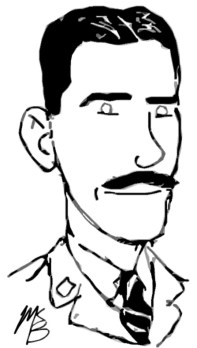
Apparently “Lest We Forget” only pertains to one day of the year, Nov 11. I refer to the shabby treatment afforded the late Lt-Col. Lee Payne by Sunnybrook. Lee Payne was a soldier Canada should be proud of. He rose from the ranks of the Irish Regiment to become its commander, an achievement few can lay claim to. I had the privilege of serving with him and knowing him … Who cares whether or not he was entitled to treatment?
(Ernie Newman, Toronto Star, 6 Jan 1958, 6)
Born in Winnipeg on 3 September 1914, Leige Clifford Harry Payne worked in the yarn business and enlisted as a private in the Irish Regiment of Canada in 1940. He earned a commission before the unit went overseas in October 1942 and became second-in-command by the end of the Italian campaign. He succeeded Lieutenant-Colonel R.C. Clark in February 1945 as I Canadian Corps prepared for redeployment to Northwest Europe.
For his role in the liberation of the Netherlands, Payne was mentioned in dispatches and he accepted the surrender of the German garrison at Delfziji on 30 April 1945. As he explained in a press interview:
Well, we brought up the artillery and beat the tar out of them. We never gave them a chance to get organized, to rest or to bring up supplies … [Nazi] Col. Walther decided the Germans had had enough and didn’t want to go any further with the argument. He asked for terms … We didn’t give them any. Three days later they called thee whole war in Europe off.
(Payne in Globe and Mail, 16 June 1945, 4)
He handed command of the Irish Regiment to Major G.C.A. Macartney in June when he volunteered for the Pacific theatre, precluded by Japan’s surrender three months later. Payne continued postwar reserve service, and rejoined the regular army during the Korean War. He served a tour in Europe but a series of administrative complaints and adverse reports brought an end to his army career. “This officer is his own worst enemy,” read one assessment. “He has the personality, intelligence and ability to be better than average. If he is to remain in the service he must show ‘guts’ enough to overcome his weaknesses not for a few months but on a long term basis.” He agreed to resign in April 1954 for failing to settle personal debts.
Following the end of this second tenure of military service, he opened a food shop in Toronto. Only a few years later, he fell extremely fill and lost significant weight. Denied treatment at Sunnybrook hospital because his illness did not appear connected with military service, Payne was admitted to another civilian Toronto hospital. When he made a complaint, the assistant superintendent at Sunnybrook responded that Payne had been deemed “the lowest priority.” He died of jaundice a few days later, on 28 December 1958 at the age of 44.
Another veteran recalled of the regiment service in Holland, “jaundice seemed to be a common ailment because of the unsanitary conditions through the country.” Despite many sickness cases the regiment had endured in the Mediterranean and Northwest Europe theatres, Payne’s disease was not diagnosed as related to wartime service.
His death and the Sunnybrook doctor’s seeming lack of concern provoked outrage among several veterans and members of the public. Even after Payne died, the assistant superintendent at Sunnybrook reaffirmed, “I feel now, just as then, that it was not an emergency. We have no reason to change our views.” He justified the refusal to treat the former colonel as Payne had been previously ruled ineligible by a pension committee.
His widow asked the Irish Regiment veteran association to investigate this troubling situation. “I’ve no direct quarrel with Sunnybrook,” she explained but felt it wrong for doctors to refuse an “obviously ill” man like her husband.
One Irish Regiment veteran angrily wrote, “Had the colonel swum across Lake Ontario, or been a member of one of our victorious football or hockey teams, the best would have been none too good … We spend thousands on our immigrants or D.P.’s but when it comes down to it, it shows how much it means to be a veteran.” Another veteran connected Payne’s case to his own failed attempt to get treatment at Sunnybrook. The denial, he explained, “To me, it was the final severance of my ties with the army in which I had served four years.”
Another letter to the editor in the Toronto Star summarized the “measure of revulsion and shame that many Canadians” would feel reading “the circumstances immediately preceding the death of Lt-Col. Leige C.H. Payne”:
How inhuman and utterly stupid the regulations of such institutions can become. Who is to say that any veteran’s ailment is not due to war service? Just because a callous pension board did not see fit to spend a few more dollars of public money to grant many well-deserved pensions or the veteran had too much pride and self respect to undergo the humiliation and red tape …
Many thousands suffer through their remaining years and go without treatment, which many cannot afford, for ailments which can be laid squarely at the door of their war service.
 World War Graphic History