Lieutenant-Colonel Bob Clark
Irish Regiment of Canada
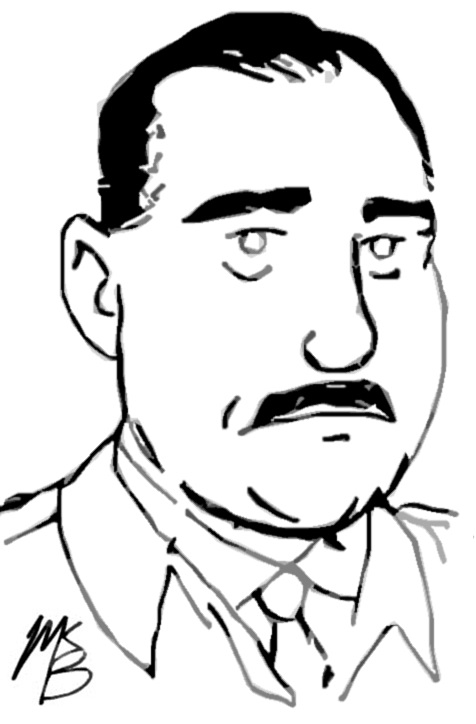
During the day, the enemy subjected the Regiment to heavy shelling, which at times became intensive. It was expected that the Regiment would remain there for a few days. The first troops to enter the town had painted “Bobby Clarkeville” on a wall, in honour of the CO, with the additional note “In bounds to all Canadian Troops.”
(Irish Regiment War Diary, 2 Sept 1944)
Born in South Africa 15 September 1903, Robert Charles Clark was son of First World War battalion commander Brigadier General Robert Percy Clark (1872–1932), an RMC graduate, and Permanent Force officer in the Royal Canadian Regiment. Nicknamed “Knobby,” he went overseas with the RCR as a captain and adjutant. Once in England, he served as brigade major for the 2nd Infantry Brigade before returning to Canada in April 1942.
Bert Hoffmeister remembered the major as “one of the laziest buggers have ever met,” “an old dyed-in-the-wool” PF officer who “drank too much.” Ironically, Clark recommended Hoffmeister’s promotion to General Chris Vokes. “Knobby was quite a seasoned type. I listened,” Vokes noted, describing Clark’s high praise for the future battalion commander and general:
Hoffmeister is good. In fact, he is excellent. He is a major now. If you ever have an opportunity to fit him in. I seriously counsel you to ask for his services. There is no such thing as a born soldier, but he is the next best thing to it. “He takes to soldiering like a duck to water.
(Vokes, My Story, 76)
On arrival back to Canada, Clark briefly commanded the Prince Albert Volunteers before being appointed the new commanding officer for the Irish Regiment of Canada in Toronto. As the regiment prepared for overseas service, it lost most of the older, First World War veteran officers including Lieutenant-Colonel H.B. Duthie and Major Alan Cockeram.
The Irish Regiment departed for England in October 1942 and deployed to the Italian theatre a year later as a part of the 11th Infantry Brigade, 5th Armoured Division, under the command of Major-General Bert Hoffmeister. Having earned the Distinguished Service Order, Clark led the regiment throughout the campaign as the Allies advanced up the Italian peninsula to the Gothic Line:
The courageous action of Lieutenant Colonel Clark and the magnificent way in which he led his Battalion relieved the pressure on Feature 111 and made it possible for the advance to continue, resulting in the final bread of the Gothic Line.
His younger brother, Lieutenant-Colonel Reg Clark, served as commanding officer of the PPCLI during the same time.
Prior to the I Canadian Corps redeploying to Northwest Europe, Clark was hospitalized on several occasions for illness. Superiors reported: “Throughout the Autumn of 44 he fought the bn in action with energy. In Nov 44 while at rest he seemed to lose interest & in subsequent operations has lacked drive and energy. He is tired out and not physically fit to comd for an extended period in the fd.” By February he had been replaced by Major Leige Payne, an original Irish Regiment officer. Clark remained in the army after the war and became commandant of Camp Borden in 1950.
He retired five years later and died of a heart attack in West Vancouver on 26 July 1967.
 World War Graphic History