Lieutenant-Colonel H.B. Duthie
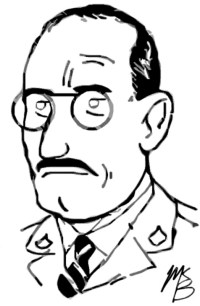
&
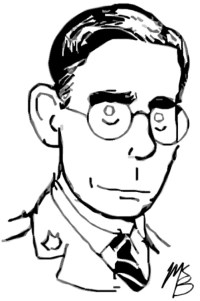
Major Alan Cockeram
Irish Regiment of Canada
I could give [the defence minister] names of officers who served in the militia in peace time, who are here doing senior staff jobs and who never saw active service. That condition is definitely wrong. I think everyone will agree that those of us who wore the uniform in peace time should fight in the front line.
(Cockeram, House of Commons Debates, 12 Jun 1941, 3926)
Born in Toronto on 28 June 1889, Harold Bruce Duthie was a contractor and First World War veteran. Commissioned on enlisting in 1917, he served with the Canadian Engineers in France during the final Hundred Days of the war. In 1938, he became commanding officer of the 1st Battalion, Irish Regiment of Canada, succeeding fellow veteran Lieutenant-Colonel Alan Cockeram. Born in Devon, England on 6 December 1894, Cockeram had earned the D.S.O. in 1917 and was member of parliament for York South. On the mobilization during the Second World War, Cockeram reverted from command of the 2nd Battalion (Reserve), Irish Regiment to go active with the 1st Battalion as second-in-command.
Cockeram had enlisted with the 21st Battalion as a private and went to France in September 1915. “If I am alive six months from now I’ll apply for leave to study for a commission,” he reasoned. He took a commission with the British Army a year later but returned to the 21st in February 1917. Although only a lieutenant, he earned the Distinguished Service Order, usually reserved for senior ranks or for exceptional bravery. The citation for his actions at the Battle of Hill 70 on 15 August 1917 read in part:
For conspicuous gallantry and devotion to duty in leading his platoon in an attack. On reaching his objective he came under heavy fire from a machine gun. Taking two men with him, he immediately rushed forward, personally killed the gun crew and then noticing that a booby trap was attached to the gun, he threw it backwards, on which the trap exploded. During this operation he was wounded but refused to leave his platoon. Later in the day while on reconnaissance with two N.C.O.s, he met a party of the enemy, all of whom were killed … His fearlessness throughout was most marked.
(D.S.O., citation 7 Mar 1918)
Cockeram ended the war as a captain and served as commanding officer of the reorganized Irish Regiment of Canada from 1936 until 1938, to be followed by Duthie. As the Toronto Star quipped following mobilization of the regiment in 1940, “we had to confess that the commander of the Irish Regiment, Lieut.-Col. HB Duthie, was not Irish, but a Scotch Canadian. Now it’s horrible to repeat that the second in command is English; straight English, with no Irish mingled in at all.”
In the March 1940 federal election, Cockeram had been elected National Government MP in York South riding by over 2,500 votes. Highly critical of the government’s war effort, he resigned in November 1941 to give Conservative Party leader Senator Arthur Meighen a safe seat to get back into the House of Commons. However, the Mackenzie King Liberals ran no candidate that would split the vote and the CCF nominee Joseph Noseworthy claimed a surprising victory over the former prime minister in the 9 February 1942 by-election.
In March 1942, Duthie informed Cockeram that all overage Irish Regiment officers would be struck off strength. The former MP suspected partisan motives for his earlier public criticism of the war effort, writing, “I think it is obvious that the department was anxious to get rid of me on political grounds.” His hopes of commanding the regiment overseas dashed, Cockeram retired to civil life. He would return to parliament in the June 1945 after defeating Noseworthy for his old seat of York South.
As Duthie was even older than Cockeram, he too was replaced by June 1942. Lieutenant-Colonel Robert C. Clark, formerly of the Royal Canadian Regiment, took over the Irish Regiment before it was scheduled to go overseas later that year.
Defeated for re-election by Noseworthy in 1949, Cockeram died in New York on 11 September 1957. Duthie died in Grimsby, Ontario on 18 October 1971.
 World War Graphic History