Lieutenant-Colonel W.S. Rutherford
Stormont, Dundas and Glengarry Highlanders
Perth Regiment
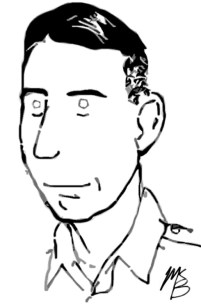
The first act was a burlesque skit, most certainly not appropriate for Christmas, in which a bid randy lumberjack in this case none other than Lieutenant-Colonel Rutherford himself, rode into town to get himself laid. And who would his ravishing partner be but none other than the best female impersonator in the whole damn Canadian Army … As for the skit, it really wasn’t all that much in the way of a professional burlesque, or acting ability, but it sure did bring on the laughs.
(Stanley Scislowski, Not All of Us Were Brave, 101)
Born in Toronto on 26 September 1907, William Samuel Rutherford was a University of Toronto graduate, Shell Oil employee, and militia officer with the Toronto Scottish Regiment since 1929. He went overseas in December 1939 but returned to Canada later the next year when posted to the 9th Infantry Brigade as brigade major. The brigade, as part of the 3rd Canadian Division, departed for the United Kingdom in July 1941. By the end of the year Rutherford had become acting general staff officer with the division.
In January 1942, he was appointed new commanding officer of the Stormont, Dundas and Glengarry Highlanders, in succession of Lieutenant-Colonel R.T.E. Hicks-Lyne, who had brought the unit overseas. During an inspection shortly thereafter, General Montgomery remarked, “We could do with some more COs like Rutherford.” After eight months at battalion command he was succeeded by Lieutenant-Colonel M.S. Dunn, an original SDG Highlander. By August 1942, Rutherford had been posting to the general staff of 2nd Canadian Division headquarters.
A year later Rutherford took up a new command of the Perth Regiment, replacing Lieutenant-Colonel H.E.T. Doucet. In October 1943, the regiment departed for the Mediterranean theatre as part of the 11th Infantry Brigade, 5th Armoured Division. In January, the Perths along with the Irish Regiment of Canada and the Cape Breton Highlanders relieved the 3rd Brigade, 1st Division, after the hard fighting at Ortona. Following heavy losses at Arielli River, the regimental history noted that over the next two months, “the Perths endured one of the most miserable periods of their war experience” holding the line along a static front.
In the private memoirs he wrote for his family, Brig-Gen. Rutherford remembers a battle near Ortona in early January 1944. It was the baptism of fire for the Perth Regiment and was meant to give them an easy introduction to war. That was not what happened. The description of the battle of Arielli reads like something from the First World War … Brig-Gen. Rutherford noted in his memoirs that the Canadian action had no real purpose.
(National Post, 24 Apr 1999, 14)
In March 1944, former Perth commanding officer Lieutenant-Colonel J.S.H. Lind arrived to replace Rutherford, who was reassigned to organize a river-crossing school at Guglionesi. He very briefly returned to the Perths on 5 May 1944 only to be recalled to Canada as senior instructor at the Royal Military College two weeks later.
Following demobilization, he resumed his work for Shell Oil but remained involved in the reserve army, rising to the rank of brigadier-general. He died in Ottawa on 13 April 1999.
 World War Graphic History