Brigadier J.S.H. Lind
Perth Regiment
12th Infantry Brigade
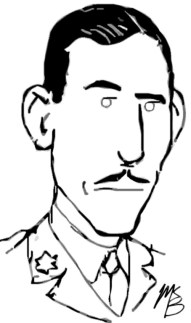
… one of the figures in the lead carrier was none other than the CO himself, Lieutenant-Colonel Lind. That a man of his rank should be right up at the sharp end was a welcome surprise … Later when we were in Army Reserve at Caiazzo, he had pinned to his tunic, the medal and ribbon of the [D.S.O.]. awarded for his leadership of the regiment in this action. In effect, we the ordinary guys in the ranks won it for him. But what was there for us to show for these efforts? Not a damn thing!
(Stanley Scislowski, Not All of Us Were Brave, 220)
Born in Owen Sound, Ontario on 17 November 1908, John Skiffington Heming Lind was a cement company executive and member of the St. Marys town council. A graduate of the Royal Military College, he had belonged to the militia since 1932. He relinquished his position as second-in-command of the Perth Regiment to attend the staff college at Camberley, England in 1940. By the time the regiment departed for England, Lind had been appointed a brigade major overseas.
Lieutenant-Colonel G.W. Little, a First World War veteran and one-time PPCLI battalion commander in 1918, relinquished command of the Perth Regiment in May 1942. Major R.L. Tindall assumed command until Lind arrived as official successor that summer. By January 1943, the Perths had been re-designated an infantry battalion from motorized infantry. the After a year of supervising regimental training and exercises in England, Lind was appointed to II Canadian Corps headquarters in May 1943. He was replaced by Major H.E.T. Doucet, formerly of The Black Watch.
Lind would not assume command of the regiment again until March 1944, this time as a battlefield commander in place of Lieutenant-Colonel W.S. Rutherford. He earned the Distinguished Service Order two months later for his actions at Liri River in the offensive against the Hitler Line:
… with his battalion being subjected to steady enemy artillery fire, he went forward to the leading platoons, who were assembling in an area which was under observed enemy shell and machine gun fire from the far bank, and, ignoring his own safety, personally directed and supervised the crossing in assault boats of his entire Battalion.
His courage, determination and personal disregard for his own safety set a high example to his men and resulted in the formation of a bridgehead across the river thus allowing the engineers to bridge and the remainder of the Division to cross and continue the advance.
Although veteran Stanley Scislowski grumbled that the ordinary soldiers received no such high honours, Lind announced that “the decoration was really for the Regiment as a whole.” The awarding of the D.S.O. came with a promotion to brigadier in August 1944. He succeeded Brigadier D.C. Spry in command of the 12th Infantry Brigade. The Perths were now commanded by Major W.W. Reid, formerly of the Irish Regiment of Canada.
After the war, Lind resumed his militia service and business career, dying in St. Marys, Perth, Ontario on 18 December 1980.
 World War Graphic History