Brigadier Leslie Booth
12th (Three Rivers) Tank Regiment
4th Armoured Brigade
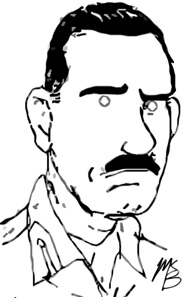
It was strange but at about the time that Simonds and I were discussing that problem I became convinced that Boothie had a premonition that he would be killed. He certainly was not the same keen and cheerful man of the year before in Sicily … I looked for him to hear what was wrong,
(Kitching, Mud and Green Field, 213)
Born in Lancaster, England on 21 April 1906, Eric Leslie Booth was engineer for the Bell Telephone Company and prewar militia officer with the Mississauga Horse. In September 1939, he enlisted with the 1st Hussars, later redesignated the 6th Armoured Regiment, and went overseas as a major in late 1941. He served for several months as second-in-command of the 17th Lancers in North Africa before being appointed to command the 12th Tank (Three Rivers) Regiment in April 1943.
Just prior to embarking with the 1st Canadian Division in June 1943, Booth broke the sealed top-secret orders revealing the convoy’s destination of Sicily. Furious, Major-General Guy Simonds threatened to remove him from command for the reckless breach of security. Simond’s general staff officer, George Kitching, pointed out they had no choice but to bring him along as he now knew the classified information. Witnessing the “cold rage” of Simond’s severe reprimand, Kitching described the five-foot-four Booth “shaking like a leaf.” Kitching stated Booth “told me a month later that his five minutes with Simonds had made him all the more determined that he and his regiment would do well in Sicily. They did.”
Retaining his command of the Three Rivers Tanks, Booth rectified the earlier mistake and earned the Distinguished Service Order for his leadership of BoothForce in August:
Lt Col Booth carried out the operation with dash and determination against strong on opposition. With complete disregard for the heavy enemy fire he personally directed the action to such good effect that all enemy resistance was quickly destroyed … It was largely due to the courage and dash displayed by Lt. Col. Booth that the important bridgehead ae secured over the River Simeto during the night.
In the Italian campaign, five months later he received a D.S.O. Bar. The citation described the conditions of frontline service at Battle of Ortona in December 1943:
The fighting was bitter and intense. Disregarding the danger from sniping shell and mortar fire, Lt. Col. Booth continually went for ward for reconnaissance and to direct arid encourage the squadron of his Regt … Booth made light of enemy fire and never allowed it to prevent his going uh are his presence was required …
His cheerfulness under fire and supreme confidence encouraged and fired thorn. His skill experience and judgment in the coordination of combined infantry and tank assaults played a large part in the success of the difficult operations, which resulted in the final expulsion of the enemy, from Ortona.
In February 1944, he was recalled from the Italian theatre to be promoted to brigadier of the 4th Armoured Brigade for the coming invasion of France. During the breakout from Normandy in summer 1944, Major-General Kitching, now his superior in the 4th Armoured Division noticed a change in “Boothie’s” personality. Gone was the cheerful commander who made light of enemy fire. Unable to locate his brigadier by radio on 8 August 1944, Kitching found Booth asleep in his tank, suspecting him to be drunk. Although the general gave him a “tongue-lashing,” he made no formal charge and allowed Booth to lead his regiment into battle.
On 14 August, the first day of Operation Tractable to close the Falaise Gap, a German 88mm shell exploded Booth’s tank. He managed to escape but was badly shot up. After numerous narrow escapes in action from North Africa to Italy, Booth succumbed to his wounds while being evacuated by field ambulance.
 World War Graphic History
Hello Matthew,
I’ve just read an account in Mark Zuehlke’s ‘Breakout From Juno’ (2011) of how my Grandfather Major Gerry Chubb saw Brigadier Booth’s tank get hit, and got him evacuated from the scene.