Lieutenant-Colonel Bob Purves
11th (Ontario) Tank Regiment
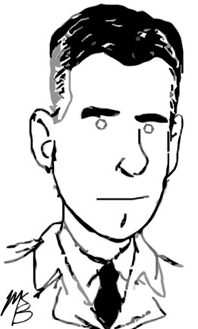
The development of mass destruction weapons will lead away from great wars, where millions of men face each other. Instead we will have a continuation of smaller wars such as Korea, Indo-China, Palestine and Malaya—all aided and abetted by one or the other of the great power blocks.
(Purves in Toronto Star, 12 Nov 1954, 7)
Born in Victoria, British Columbia on 13 October 1910, Robert Lloyd Purves was a University of British Columbia graduate and schoolteacher in Calgary. Having belonged to the prewar reserve army with the Calgary Highlanders, he mobilized for active service in early 1941. He would serve with each of the three tank battalions in the 1st Canadian Armoured Brigade; as squadron commander in the 14th (Calgary) Regiment at Dieppe, second-in-command of the 12th (Three Rivers) Regiment, and commanding officer of the 11th (Ontario) Regiment.
In January 1944, Purves replaced Lieutenant-Colonel Bob Schell of the Ontario Tanks. He led the regiment throughout the Italian campaign and earned the Distinguished Service Order for his “personal example of courage, resource and determination” at the Gustav Line in May 1944:
There was no hope of getting across without tank support. Lt-Col. Purves was sent forward by the brigade commander to lead his squadron personally at this critical moment of the battle. Showing the utmost disregard of danger, refusing to close down his tank, and constantly outside it on the ground, he eventually managed to get a few tanks across the marshes and hills by the river, in spite of very heavy fire, mines and Germany infantry.
(D.S.O. citation, 17 Mar 1945)
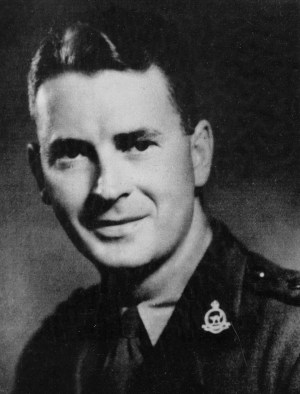
Courtesy of Rod Henderson, Ontario Regiment historian
After over sixteen months in command of the ONTRs, Purves relinquished command to Major Charles McLean near the end of the war in Europe.
Promoted colonel in 1948, Purves became director of Royal Canadian Armoured Corps with army headquarters. In 1951, he went to Washington, D.C. as chief of staff and a military attaché for the Canadian Army. By the early 1950, he had been promoted to brigadier with Central Command.
At the height of Cold War tensions, he provoked some controversy when he appeared to suggest in a 1954 speech that major population centres were not “vital areas” for military defence. “The term vital points, which is peculiar to the army,” he clarified, “does not mean vital points in the sense of aerial attack. It certainly doesn’t mean that Toronto, Vancouver, and Montreal would not be given every military defence in the event of attack.”
Purves served numerous posts with army headquarters and later commander of Camp Borden. Previously troubled by heart problems for at least a decade, he died on 20 June 1967 in Newmarket, Ontario.
 World War Graphic History