Lieutenant-Colonel John Begg
14th (Calgary) Tank Regiment
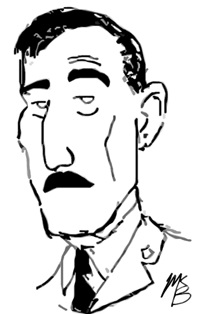
It’s a personal war with this unit now. We were the first Alberta regiment and the first armored regiment to see action. Give us time to refit and we’re going back.
(Begg in Calgary Herald, 24 Aug 1942, 1)
Born in Lanarkshire, Scotland on 18 Mar 1899, John Begg had started in the Cyclists Corps in the First World War and commanded a tank regiment in the second. An accountant with the Canadian National Railway, he had been commissioned in the Calgary Regiment in 1922 and became a major in 1936 when it was redesignated a tank battalion. He served as second-in-command stationed with the “floating reserves” during the Dieppe Raid on 19 August 1942.
The landing craft of commanding officer Lieutenant-Colonel John Andrews came under heavy fire as it attempted to land. With his tank sinking, he attempted to bail out but disappeared and was presumed killed. “He worked his men hard,” Begg said of Andrews’ determination. “But he worked himself harder. And then he went in with his men.”
Now in command from the reserves held offshore, Begg tried to land his tank but his craft was forced back under heavy fire. He directed the operations from the sea, following the battle’s progress from the radio traffic on the beaches. “The boys on the air,” Begg reported, “acted just as if they were on parade. I never heard a word of panic.” After the evacuation which left the tanks disabled and abandoned, he led the remnants of the battalion back to England.
In October 1942, Begg received the Distinguished Service Order for his leadership in the raid:
At great personal risk and with complete disregard for his own safety he succeeded in having two of the three tanks on board land safely. Lt-Col. Begg directed the handling of these tanks under a frontal fire so intense that many members of the landing party and crew were seriously injured, the craft itself being almost completely destroyed. He was at all times an inspiration of coolness and courage to those remaining alive on his craft.
Wounded in an air raid, Begg relinquished command in April 1943 to Lieutenant Colonel C.H. Neroutsos and returned to Alberta. Battalion chaplain Waldo Smith stated of Begg:
He had taken over after Dieppe and had steered the unit along with good judgment. He was one of those veterans of World War I who, through the years that followed it, had worked faithfully at the thankless task of keeping the militia in being. These officers and senior N.C.O.’s were too old now for active service but they had been indispensable in the mobilization and first training of the active service force. Younger men got the headlines when the army went into action but those older men gave faithful and effective service up to the end.
(Smith, What Time the Tempest, 96)
“They were simply magnificent,” Begg reassured people at home when asked about the Dieppe raid. “They landed under terrible conditions and they fought their way inch by inch toward their objective. Those who were captured simply ran out of fuel and ammunition and they had no other alternative.” The next month, Begg was appointed to command the armoured corps training regiment at Camp Borden. He returned to the reserves in 1944.
He died in Calgary on 24 November 1980.
 World War Graphic History