Lieutenant-Colonel Drayton Walker
Saskatoon Light Infantry
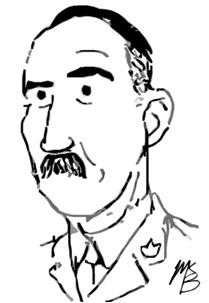
We will NOT be neutralized. Nothing the enemy can do will be allowed to stop our fire. We have not the honour, nor do we have the sacrifices of hand-to-hand combat, but we can ensure that we will never be called upon in vain to answer a call for fire. Whatever the entails, whether it be selection of positions, preparation of gun or mortar sites or state of readiness, it will be done.
(Walker, Part 1 Orders, war diary, 16 Jan 1945)
Born on 16 May 1900 in Maple Creek, Saskatchewan, Drayton Earnest Walker was a Saskatoon teacher and militia officer. Commissioned in the Prince Albert Volunteers since 1922, he volunteered for active service with the Saskatoon Light Infantry at the rank of major in September 1939. He put his teaching skills to use instructing NCOs and new officers on military duties, Newly commissioned Lieutenant H.C. Mitchell wrote of this training under Walker’s guidance: “In three weeks we covered the rudiments of army life as for a machine gunner. I have always regarded that course as being the initial base upon which the record of our battalion was built.”
It wasn’t that we learned so much. It was the attitude to our job that we learned that was so important. We were the Non Commissioned Officers and officers from all Companies, of the Battalion. That course was the first unifying influence in our Battalion and it set the standard for our future training. Few men had a greater influence on the SLI in 1939-45 than Drayton Walker.
(Maj. H.C. Mitchell, Wartime Exploits, 11)
He served in the Italian campaign as company commander, earning a reputation of a frontline officer who called on soldiers “to follow me.” Although wounded by shrapnel following an “epic attack” on 15 December 1943 near Ortona, he remained on duty and received the Distinguished Service Order:
Nevertheless, he gallantly continued to direct the fire of his weapons until the retention of the position was assured … The cool efficiency and courageous devotion to duty displayed by this officer under withering fire, his determination and skill contributed in large measure to the success of the initial and subsequent operation and set an inspiring example to the entire brigade.
Lieutenant-Colonel J.A. Calder called him, “an outstanding soldier and the coolest and most composed under fire of any company officer he ever had under his command.” Walker became second in command to Lieutenant-Colonel A.W. Embury when Calder was elevated to Brigadier in July 1944.
By January 1945, he succeeded Embury who had returned to Saskatchewan to take his seat in the provincial legislature. On his promotion he reminded the troops of their essential responsibilities: “We will never be satisfied with the support we are giving to the infantry. Somehow or someway, we can do something TODAY to better it … Our job is not merely to give support but to give better support. The best is still ahead.” Walker commanded the SLI until the end of the war.
Walker returned to teaching in Saskatchewan and became a high school principal. The same enthusiasm he used to the support of infantry in wartime, he brought to the education of students in the classroom. “He always believed we should do more for kids,” a teacher recalled, “He would just would not give up on them.”
In 1963, Walker went on loan to the Department of National Defence to be principal of the school for children of armed forces personnel in Europe. He died on 15 November 1975 in Lee County, Florida.
 World War Graphic History