Lieutenant-Colonel Jack Pangman
Carleton and York Regiment
Essex Scottish Regiment
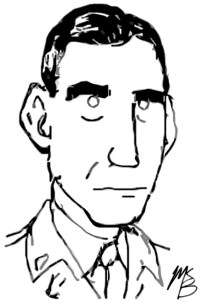
We have entered a major war. Industry is anticipating or is already sharing in the increased money put into circulation by our war effort … The war profits of the present struggle will not accrue to the common shareholders so directly or fully as was the case in the last war. This time government control of prices and excess profit taxes should be an effective rein on large profits. Industry will have to pay its share of the war costs.
(Pangman, Financial Post, 20 Jan 1940, 8)
Born in Toronto on 12 June 1908, John Edward Case Pangman was a stockbroker and fifteen-year prewar member of the Queen’s Own Rifles. He mobilized for active service in June 1940, and went overseas with the regiment as second-in-command the following summer. After attending the War Staff College at Camberley, England, he was posted to Sicily to replace Lieutenant-Colonel F. Dodd Tweedie of the Carleton and York Regiment in August 1943.
His younger brother happened to be Major G.F.C. Pangman, brigade major to Brigadier Matthew Penhale who had lost confidence in Tweedie after the Sicily campaign. The change provoked opposition from several CYR officers, especially after the second-in-command was replaced by another outsider, Major E.D. Danby of the Seaforth Highlanders. When some officers requested transfers, Penhale ordered the remaining company commanders to offer full support to Pangman and Danby.
Shortly after the invasion of Italy in September 1943, Pangman “received a welcome like a mob scene” with his liberation of a dozen Allied prisoners held since the North African campaign. After over four months fighting up the peninsula, Pangman was relieved in early January 1944 after the Battle of Ortona. Especially shaken by heavy casualties suffered on 31 December and feeling unsupported by superiors, he was heard to remark that one of his companies “was being decimated.” Major Danby assumed command in his absence.
Pangman was posted to Canadian Military Headquarters as a general staff officer. Almost ten months later, on 26 September 1944, he went back into action in Northwest Europe, replacing the wounded Lieutenant-Colonel P.W. Bennett of the Essex Scottish Regiment. He led the battalion during some of the fiercest fighting in the final push into Germany.
For organizing a desperate defence against relentless enemy counterattacks on 19 February 1945, he earned the Distinguished Service Order. Although the citation read, “By his coolness and courage Lieutenant Colonel Pangman set an example for his Regiment which will never be forgotten,” the casualties again had a profound impact and left him deeply shaken.
A former subordinate of the Queen’s Own Rifles later described relieving the Essex Regiment:
Although we’d considered him stand-offish, we’d appreciated him as a disciplined soldier and a good planner.
We were moving forward to the start line when I saw him. He was dirty and gaunt, tears running down his cheeks. It was hard to compare this man with the major I’d once known when he said, “Good less you in this. We took terrible losses and still didn’t get the objective.” He’d come to realize how war makes us equal.
(Martin, Battle Diary, 116)
Following hospitalization, Pangman briefly rejoined the Essex after VE-Day but was posted back to Canada a few days later. On arrival home, when praised for the courage that had won him the D.S.O., he emphasized that company commanders and platoon leaders did the actual fighting. In modern warfare, he claimed, a battalion commander “sticks quietly to his knitwork in the safety and comfort of his headquarters.”
In the same press interview he added, “the war ended a couple of months before I thought it would … The opposition in front of us, in the front lines, seemed hard to reconcile with the optimism at home.”
Pangman remained in the army and earned a promotion to brigadier in 1952. He commanded the 27th Canadian Infantry Brigade in Germany and later the Manitoba Area from 1959 until retirement in 1963.
He died in Lake of the Woods, Ontario on 7 August 1987.
 World War Graphic History