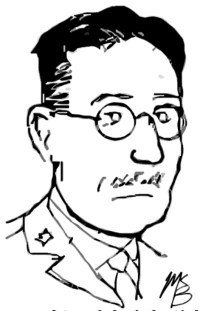
Lieutenant-Colonel F. Dodd Tweedie
Carleton and York Regiment
This is a hazard faced by all historians, since none of their major sources, be they documents or oral testimony, are infallible, and judgement have to be made on the balance of probability. Thus most narrative history may be, at best, no more than an approximation of what actually happened.
(Tweedie, foreword to Tooley, Invicta: The Carleton add York Regiment in the Second World War, vii)
Born in Centreville, New Brunswick on 14 September 1901, Frederick Dodd Tweedie was an Edmundston lawyer and active member of the Rotary Club. A prewar militia major, he succeeded Lieutenant-Colonel W.C. Lawson in command of the Carleton and York Regiment in February 1942. While he was responsible for training and leading the regiment for over a year before it went into action in Sicily, by the end of August he would be unceremoniously removed.
Feeling that the regiment’s had performed well in the campaign under uneven leadership, Brigadier M.H.S. Penhale of the 3rd Infantry Brigade lost confidence in Tweedie as a battalion commander. Tweedie in turn had little trust in Penhale as a brigade commander. As a result of the personality clash and the loss of an entire platoon in an ambush, by August 1943, Tweedie was replaced by Lieutenant-Colonel J.E.C. Pangman, former second-in-command of the Queen’s Own Rifles.
Penhale had filed a confidential report that Tweedie “Lacks tactical aptitude and initiative in meeting battle situations. Has not got the capacity to inspire the unit or to maintain morale at high level under difficult circumstances. I regret to state I have not got confidence in his power of leadership in battle.” Tweedie, whose recollections and interviews provided much material for Robert Tooley’s regimental history Invicta, was according to the author express no bitterness about the change in command:
It is pleasant to be able to record of this distasteful episode that at the age of 86 Lt. Colonel Tweedie bears no overt resentment at his treatment, but discusses it dispassionately, emphasising that, regardless of what happened on that day in August 1943, he can look back with pride at having been both Second-in-Command and Commanding Officer of his battalion.
(Tooley, Invicta, 142)
Penhale would be removed as brigade commander for indecisive and hesitating leadership in October 1943.
With his legal background and expertise, Tweedie served as court martial president for hundreds of trials in North Africa and the United Kingdom. One of his first cases after being removed from command concerned an RCMAC captain cashiered for scandalous conduct after being found in a brothel. Ironically, one of Tweedie’s first duties on taking over the CYR in February 1943 had been promulgating the dismissal of a captain court martialled for absence without leave.
In summer 1944, Tweedie requested release from the army to resume his law practice. He was president of the Law Society of New Brunswick Law Society of New Brunswick from 1959 to 1961. He died in Grand Falls, New Brunswick on 20 May 1995.
 World War Graphic History