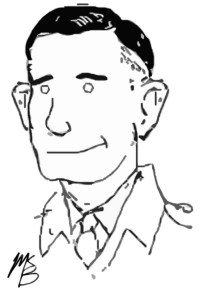
Major W. Winston Mair
West Nova Scotia Regiment
Every Canadian must find his or her own answer to this problem of modern life. But we do have a responsibility to ensure that the answer does not lie behind a closed door—closed because we failed to think and act courageously and well … We also know that our outdoor heritage could slip away from us, while we ponder our choice of action in the name of progress.
(Winston Mair, North Bay Nugget, 10 Apr 1964, 3)
Born on 26 July 1914 in Battleford, Saskatchewan, William Winston Mair was an environmentalist and civil servant following service in the Second World War. Commissioned in August 1940, he joined the Saskatoon Light Infantry overseas and participated in the Spitzbergen Raid in Norway a year later. He served with the unit at the rank of major in the Italian theatre.
In 1944, he volunteered for the Canadian-American commando unit known as 1st Special Service Force. Following intensive training in assault tactics and mountain warfare, he was attached as executive officer to the unit’s 1st Regiment. He participated in the assault on the islands of southern France before the invasion of the mainland in Operation Dragoon in August 1944.
When the unit was disbanded at the end of the year, he was attached to the West Nova Scotia Regiment. He served as a company commander in the final campaign in Northwest Europe and in June 1945 succeeded Lieutenant-Colonel J. Aird Nesbitt who had become acting commander of the 3rd Infantry Brigade. Mair handed command over to Major Harry Eisenhauer in September when promoted to lieutenant-colonel and camp commandant of Canadian Army headquarters in the Netherlands.
Entering the University of British Columbia in 1946, Mair completed his bachelor’s degree in forestry and a masters in wildlife management. On graduation in 1952, he was hired as chief of Canada’s Wildlife Service. He was then chief of the National Parks Service from 1963 to 1966, when he became provincial deputy environment minister in Manitoba and later British Columbia.
Retiring from the civil service by the late 1970s, Mair worked as an environmental consultant. He notably resigned as chairman of a panel set up to assess the impact of the Alaska Highway Gas Pipeline in 1981. Arguing that Indigenous peoples had not been consulted, Mair earlier warned, “Historically, we in Canada have developed a substantial number of major projects in our hinterland without much concern for those people who lived in the immediate area … But we know now that local benefits have frequently been marginal while adverse impacts have often been great.”
He died on 22 January 1990 in Victoria, British Columbia.
 World War Graphic History