Lieutenant-Colonel Allan Saunders
West Nova Scotia Regiment
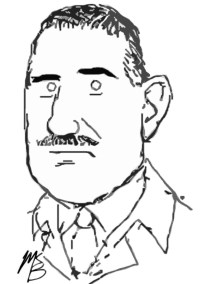
Is conscientious and hard working … As [commander] he lacked confidence in himself and has apparently been unable to inspired his coy comds in carrying out their tasks. Under stress is pessimistic and indecisive and both these characteristics are communicated to his subordinates. He is not firm in assessing and dealing with shortcomings of his subordinates. Consider Saunders does not have required personality or qualities of leadership to comd inf bn in action.
(Adverse confidential report, Jan 1945)
Born on 24 April 1903 in Waterford, Ontario, Allan Livingston Saunders was a steel company general manager and militia officer with the York Rangers. He went overseas as captain in 1940, returned to take a course at RMC, and qualified as a general staff officer. While serving with the 1st Canadian Division in Italy, in September 1944, he was appointed the new commanding officer of the West Nova Scotia Regiment.
His predecessor Lieutenant-Colonel R.S.E. Waterman had been removed following losses at the Foglia River crossing on 30-31 August. Saunders evidently proved unable to restore the unit’s morale and effectiveness. After a partially successful operation at Lamone River crossing on 21 December 1944, he was subject to an adverse confidential report with a recommendation for a “change of employment.”
Saunders protested this critical appraisal, arguing that his service and experience as a staff officer “entitle him to a sufficiently long tour of duty as Lt Col to enable him to be returned to civil life in that rank.” Although superiors suggested a return to general staff officer duties, with no vacancies in the field he returned to the United Kingdom.
Prior to relinquishing command of the West Nova at the end of December, he discussed the situation with battalion chaplain Laurence Wilmot, who explained:
The regiment had failed to accomplish all that had been expected of it at the Lamone River crossing and someone must be held responsible, despite the fact that the men could not have done better under different leadership given the situation they faced. Someone must pay for mistakes, and those higher up never considered that it might have been their mistake in asking the impossible … [Saunders] took the situation calmly and philosophically, knowing that he had done his best under the circumstances.
He was replaced by second-in-command Major Frank Hiltz.
As a surplus senior officer, Saunders appeared before an Officer Survey and Classification Board in February 1945. The board found him: “Tall and of strong rugged build this offr is of neat appearance and good mil bearing, appears to be conscientious, serious and a hard working offr. He has a pleasant manner and personality. He is self-assured and is rather of the experienced business executive type.”
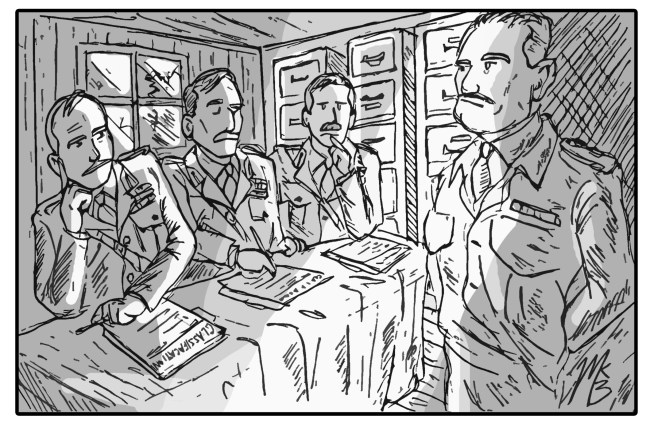 In the course of the interview, the board noted Saunders “feels very keenly that he has been made the victim of circumstances in a large measure beyond his control.” It recommended retention for other duties at the rank of lieutenant-colonel. Saunders remained overseas and while commanding a base unit in the Netherlands even hosted an informal reunion for some WSR officers in September 1945.
He died in Toronto on 27 April 1969.
 World War Graphic History