Lieutenant-Colonel Ronnie Waterman
West Nova Scotia Regiment

A professional soldier of the Canadian permanent force, tough, colourful, jealous for the honour of his Regiment in battle or out of it, not always loved but always acknowledged a first-rate leader of men, he was destined to see the West Novas through some of their toughest battles and greatest glories and to make the Regiment famous throughout the Canadian Army.
(Raddall, West Novas: A History, 169)
Born in London, England on 25 November 1904, Roland Stephen Edward Waterman was a non-commissioned officer with twelve years in the Princess Patricia’s Canadian Light Infantry. Nicknamed “Ronnie the Rat,” according to C. Sydney Frost of the PPCLI, “Everyone was scared of him, not only because of his abrupt and intimidating manner but because he knew his stuff and was a highly professional soldier.” Commissioned in September 1939, Waterman was reassigned from the PPCLI to the West Nova Scotia Regiment in June 1943, shortly before the invasion of Sicily.
When Lieutenant-Colonel Pat Bogert was wounded at Ortona in December 1943, Waterman took command of the West Novas. Newly arrived battalion chaplain Laurence Wilmot recalled the new CO “gave outstanding leadership throughout the remaining ten days of battle.” Although Waterman had been initially skeptical of the chaplain, he eventually came to trust Wilmot as an advisor. “Ronnie was a superb actor,” the chaplain later wrote, “and had a way of speaking that kept you guessing until the final word whether his reaction was positive or negative.” Some called him the most respected but also the most hated battalion commander in the Canadian Army.
Waterman earned the Distinguished Service Order for leading an assault against the Hitler Line on 23 May 1944. “His complete coolness and personal example,” the citation read, “instilled a feeling of confidence and determination in his men. They succeeded in carrying out a courageous and successful attack against strongly armed and positioned enemy.” A fellow officer credited Waterman:
The manner in which you fought with the regiment is a fitting tribute to your reputation and ability as a soldier in the true sense of the word. Not everyone realizes that due to different circumstances it is not given, in this war, the opportunity for commanders to perform deeds of personal gallantry … You were their guide and more important, their inspiration, without which little is accomplished.
Despite the commendations and decorations, Waterman would be unceremoniously relived from command by mid-September 1944 after a failed attempt to break the Gothic Line. The West Novas had suffered terrible casualties at the Foglia River on 30-31 August. Superiors blamed the battalion commander for the “debacle” and felt a change in leadership necessary. Major-General Chris Vokes broke the news to Waterman over drinks, relating their conversation from his own perspective:
“I hesitate saying this and doing this to you. You have been a first class battalion commander. But now you seem to have gone to pieces.”
There, it was out. I waited for his reaction. He sat up, straight, proud and I imagine a little resentful but not too much chagrined at the way the evening had turned out buoyed as he had been by good food and drink. Perhaps he was actually relieved.
“Oh, that’s all right, general. That’s fine. I started this war as a lance corporal in the Patricias. As you know. I was commissioned. I’ve commanded a battalion in action. I’ve won the [D.S.O.]. I’m quite happy to go.”
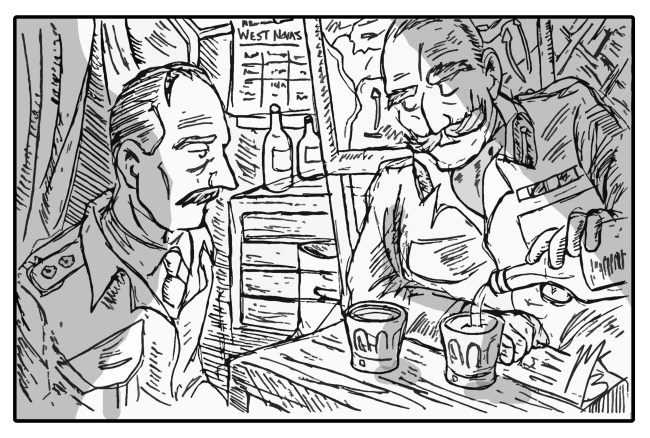
Whether his removal was as mutual as Vokes described is unknown. Regardless of Waterman’s attitude, after nine months, he was replaced by Lieutenant-Colonel A.L. Saunders, a general staff officer with 1st Canadian Division.
In his memoir, battalion chaplain Wilmot reflected:
It was sad to see him go. He was the most colourful and dynamic leader the regiment had had during my time with them, and at times his leadership had been brilliant. Whether or not he had been entirely responsible for the debacle at the Foglia River crossing will never be known, but he, as commanding officer, had to accept the responsibility and pay the price for failure.
Waterman died in Vancouver on 14 May 1959.
 World War Graphic History
Thanks for putting this together.
You’re welcome and thank you for reading!
1 small correction on his name: Ronald Stephen Edward Waterman is not completely correct. While his nickname was “rotten Ronnie” and often referred to as Ron, his first name was Roland.
Thanks! Now corrected