Brigadier Pat Bogert
West Nova Scotia Regiment
2nd Infantry Brigade
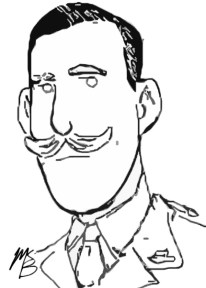
He always seemed to rise to the occasion when the going got tough, and set a wonderful example. He was an extremely brave man, and was invariably to be found somewhere up forward, personally leading the battalion, however stiff the climb or hard the marching. When he gave an order one always felt that his reasoning was sound and that he would not knowingly send you into an untenable position.
(Bill Thexton, quoted in John Gardam, Canadians in War and Peacekeeping, 10)
Born on 17 March 1908 in Toronto, Mortimer Patrick Bogert was an RMC graduate and Permanent Force officer since 1930. Still a lieutenant with the RCR shortly before the outbreak of the war, he rose quickly following mobilization and served as a general staff officer with the 1st Division. By late 1941 he was a lieutenant colonel attached as an observer with the British Army in Egypt and Libya. With this fighting experience from North Africa, he took command of the West Nova Scotia Regiment from July 1942 until January 1943, when temporarily assigned to staff of II Canadian Corps. By popular demand of his officers, he resumed command in June 1943.
Unsatisfied with Bogert’s replacement, Lieutenant-Colonel R.D. King, the West Nova officers had nearly mutinied at the prospect of going into battle without a trusted leader. When Bogert reappeared as the troops boarded their transport, one officer recalled, “never did you see such a happy group.” On 10 July 1943, the regiment landed in Sicily with the rest of the 1st Division.
During the early Italian campaign in September 1943, Bogert led a mobile, combined arms formation that included the West Nova infantry, tanks, artillery, and engineers known as “BoForce.” One veteran attributed its success to “confidence built on mutual respect that was a credit to the entire regiment.” For his actions on 9 October 1943, Bogert earned the Distinguished Service Order:
Lieutenant-Colonel Bogert, by a quick, accurate appreciation and cool, forceful leadership retained the initiative. Driving the enemy from their new positions and inflicting many casualties, he led his regiment through a pouring rain to his final objective, over ground which, owing to mud, rendered movement under dire difficult and hazardous.
He was wounded at Ortona on 12 December 1943 and put out of action until April. He returned to the 1st Division as general staff officer, took temporary command of the 3rd Infantry Brigade in September, and officially assumed command of the 2nd Brigade from October 1944 until after the end of the war in Europe.
Continuing an army career, Bogert was director of military training in Ottawa when selected to take over the 25th Infantry Brigade in the Korea War. He replaced Brigadier John Rockingham in April 1952 and one year later handed command to Brigadier J.V. Allard. Bogert retired as a major-general in 1962.
He died on 16 October 1999 in Salisbury, Wiltshire, England.
 World War Graphic History