Lieutenant-Colonel Jim Stone
Loyal Edmonton Regiment
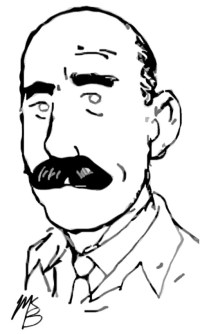
Persons who are not exposed to the bullets and shells in a slit trench situation or having to advance over open ground against a determined enemy should be very careful of using the words “cowardice,” “yellow,” and “malingerer.” Sooner or later, in those circumstances, we would all break down, some sooner than others.”
(Stone quoted in Copp and McAndrew, Battle Exhaustion, 70)
Born in Winterbourne, Gloucestershire, England on 2 August 1908, James Riley Stone immigrated to Alberta in the late 1920s and worked in a forestry camp. He volunteered as a private with the Edmonton Regiment on mobilization in September 1939 and went overseas as a lance corporal. He gained a commission in March 1942 and proved to be one of the battalion’s fiercest fighters in the Italian campaign.
For extraordinary heroism at the Battle of Ortona in December 1943, he earned a promotion to major and the Military Cross. Following several command changes over the coming months, Stone succeeded Lieutenant-Colonel H.P. Bell-Irving in October 1944. He led the Edmonton through heavy fighting at the Gothic Line and the liberation of the Netherlands. Having already earned a Distinguished Service Order in Italy, the citation for his first Bar read in part:
There were many instances throughout the actions in Italy and Holland where Lt-Col. Stone’s personal leadership was the contributing factor in the success of battle. His initiative and courage are unsurpassed. He was highly regraded throughout the whole of the 1st Canadian Division as a keen, capable and courageous commander.
(D.S.O. Bar citation, 10 Nov 1945)
“There is no exaggeration about the brutality of the Nazis,” he confirmed to the press, describing scenes of mass graves and brutalized corpses. In May 1945, he left for Alberta to form a new battalion of the Edmonton Regiment for the anticipated Pacific theatre. “It just fizzled out and no one was enthusiastic when V-E Day came,” he explained of the end of the war in Europe. “There was nothing dramatic like the last shot being fired.” Japan’s surrender meant he missed the opportunity to lead his old command back home, which for a man who had enlisted as a private, “would have been the greatest thrill of my life.”
In the late 1940s, he partnered with Lt-Col. Syd Thomson of the Seaforth Highlanders Regiment to build a tourist resort Sandy Point at Salmon Arm, British Columbia. However, both soon bored of the business and sought new challenges. Thomson joined the United Nations Military Observers Group on the Indian-Pakistan border region in the 1950s. Stone was appointed to command the 2nd Battalion, PPCLI in the Korean War.
“I’m back in the army because I figure we are on the verge of the greatest war in history,” he explained shortly before departing for the Far East. In the Battle of Kapyong on 23-24 April 1951, the PPCLI held off a relentless Chinese assault with Stone famously declaring, “No retreat, no surrender.” He earned a second D.S.O. Bar for his command of the PPCLI through the conflict.
After the Korean War, Stone was promoted to colonel and made director of the Canadian Provost Corps. He received the Order of Canada in 1994 for his work with the Military Police Fund for Blind Children, which he formed after his infant daughter had been blinded by cancer.
Stone died in Victoria, British Columbia on 24 November 2005 at the age of 97.
 World War Graphic History