Major-General George Kitching
Edmonton Regiment
11th Infantry Regiment
4th Canadian (Armoured) Division
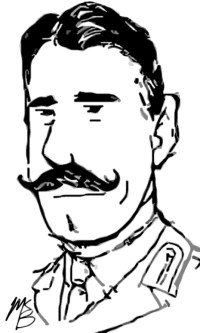
To command an infantry battalion must surely be the most rewarding command of any in the Army. It is the last time in the chain of command that you actually command men whose allegiance is to you because in our system the regiment or battalion is the cell on which brigades, division and corps are based. In the Army, loyalty is something that cannot be stretched too far. I do not think you can ask anyone to be “loyal” to a corps, division or brigade.
(Kitching, Mud and Green Fields, 130)
Born on 9 September 1910 in Guangzhour, Canton, China, George Kitching was a professional British Army officer and graduate of the Royal Military College at Sandhurst. Following Far East postings to Singapore and India with the Gloucestershire Regiment, Kitching suddenly resigned his commission and moved to Montreal in 1938. He joined the Royal Canadian Regiment on the outbreak of the Second World War and was attached with the 1st Canadian Division overseas as a staff officer.
In July 1942, General Harry Crerar selected Kitching to replace Lieutenant-Colonel E.B. Wilson of the Edmonton Regiment. He was to shakeup the senior officers and remove those “too old, too slow in their thinking.” Crerar, however, suggested “my English accent might upset some of the troops—maybe I should Canadianize it!” Proud of his brief period in command, Kitching noted, “A great deal of knowledge had been pumped into the regiment. What it needed now was someone who had enough experience in the Army to put the knowledge gained to good purpose and to steer it in the right direction.”
Four months later, in December 1942, he became general staff officer for the 1st Division under General Harry Salmon until his death and then General Guy Simmonds. In this role, he took part in the Canadian plans for Operation Husky, the invasion of Sicily and Operation Baytown, the invasion of Italy. In November 1943, Kitching was elevated to take command of the 11th Infantry Brigade in the 5th Canadian (Armoured) Division. He recollected, “The 1st Canadian Division had been my home for nearly four years and I was genuinely sorry to leave even though I was to be promoted.”
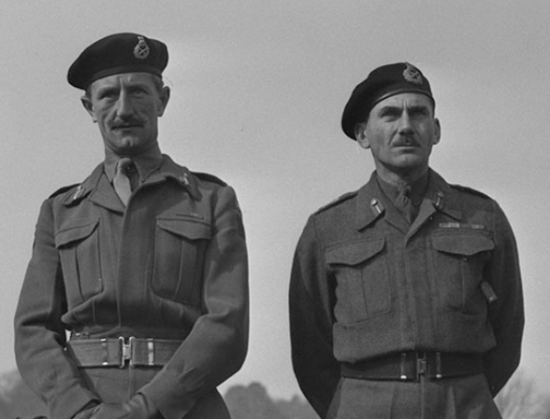
Kitching and Gen. Guy Simonds, LAC 3205307
After four months on the front in Italy, he was recalled to England in February 1944 to take over of the 4th Canadian (Armoured) Division. “If I had not been seated at the time I would have fallen down,” he thought on learning the news. “I read and reread the message ten or fifteen times to make sure I wasn’t dreaming.” He replaced Major-General F.F. Worthington, the veteran soldier who had originally trained the division. In his memoir, Kitching explained the difference between leading a battalion compared to a large formation:
Command in the Army is a very personal responsibility within a regiment or battalion. When one, as a corporal, commands a section of 8 or 9 men; or, as a lieutenant or sergeant, commands a platoon of 30 men, you are their leader. You must inspire them to the extent that they will follow you no matter how unpleasant the job may be. This feeling of personal loyalty and trust between soldiers and their leaders extends to the company level or about 120 men and to the battalion of 800-900 men. But it stops there.
The 4th Division landed in the Normandy in early July 1944 and was in action almost continuously through Operations Totalize and Tractable in late August. On 21 August, II Corps Commander Guy Simmonds told Kitching he was to be relieved of command after the failure to quickly close the Falaise Gap. “I was naturally very shocked and emotionally upset so I can remember very little of our meeting,” Kitching later noted, “except that there were no harsh words spoken between us.”
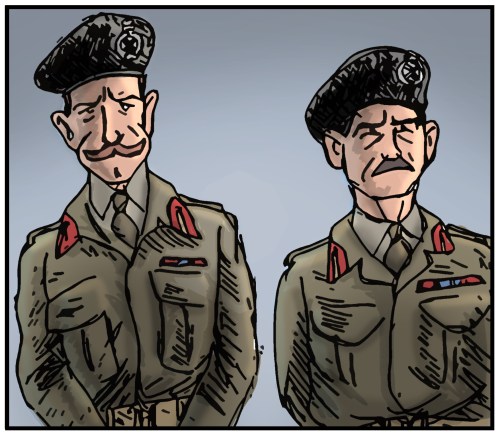
“Under the circumstances I don’t think anyone else could have done much better with the Division than I did,” Kitching would later write, trying to justify his decisions and reputation. He was demoted to brigadier and placed in command of the 13th Infantry Brigade, which had arrived to England a few months earlier. By October 1944, he was back in Italy as chief of staff to General E.L.M. Burns of I Canadian Corps. Soon thereafter Burns was replaced by Major-General Charles Foulkes, who Kitching had served with in Normandy.
When I Corps redeployed from Italy in March 1945. Kitching returned to Northwest Europe, where he witnessed the German surrender in the Netherlands. “We were bloody glad it was over,” Kitching recalled on the fortieth anniversary of the war’s end. “The enemy was beaten. For God’s sake, let’s all go home.”
Although he had been in Canada only a short time before the start of the war, he remained in the Canadian Army for another twenty years, retiring as a major-general in June 1965. He published his memoirs of his long and eventful military career, Mud and Green Fields, in 1986.
Kitching died in Victoria, British Columbia on 15 June 1999.
 World War Graphic History