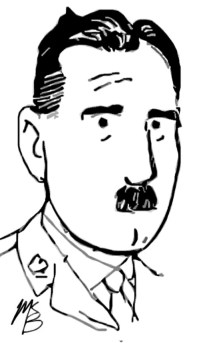
Lieutenant-Colonel Ernie Wilson
Edmonton Regiment
Since I have been in this theatre I have seen considerable numbers of both officers and men of the unit and I can assure you that not only will they doubly appreciate your thoughtfulness but that in the case of the Loyal Edmonton Regiment they are all extremely proud that the regiment bears the name of the city, coupled with the honor ‘loyal’ bestowed by His Majesty.
(Wilson to Mayor Fry in Edmonton Journal, 14 Aug 1944, 9)
Born in Innisfail, Alberta on 2 March 1904, Ernest Brown Wilson was King’s Counsel and a graduate of the University of Alberta, where he had belonged to the Canadian Officers Training Corps. He went overseas with the Edmonton Regiment in December 1939 and succeeded Lieutenant-Colonel W.G. Stillman in August 1940. He remained in command in England for almost the next two years.
After such an extended period of command, higher-up felt that the Edmontons “needed a real shakeup” especially after some troops had booed General Andy McNaughton. In July 1942, Lieutenant-Colonel George Kitching took over the battalion and Wilson became assistant adjutant and quartermaster general with the 1st Canadian Division. In May 1943, he transferred to 2nd Division with the same position.
By summer 1944, Wilson was in Italy as head of administration for the Canadian headquarters in Rome. His position allowed him to see his old unit then serving in the Italian theatre. He was pleased to report “that there are still a far greater proportion of the originals serving than I though would be, and all new and old, are doing a grand job.”
He wrote to Mayor John Fry of Edmonton:
Many officers and men will have completed five years overseas service in December and naturally being on the move continually, in action and scattered among other units as soldiers do get scattered, they have not much up-to-date news of what has happened in northern Alberta since they left.
However, they display the keenest interest in post-war Canada, particularly in those things they know will affect themselves and their families, such as rehabilitation, pension, employment, unemployment insurance, housing programs.
Given his concern about the troop’s social welfare and future prospects, the Loyal Edmonton Regiment nominated Wilson as their soldier-candidate ahead of the November provincial 1944. The Alberta legislature stipulated three non-partisan seats to represent each of the three military branches. Wilson placed third of twenty-two army candidates. The winner, James Harper Prowse, would go on to have a long political career.
Wilson ended the war as a brigadier with the Quartermaster General’s Branch.
He died in Edmonton on 10 December 1958.
 World War Graphic History