Lieutenant-Colonel J. Douglas Forin
Seaforth Highlanders of Canada
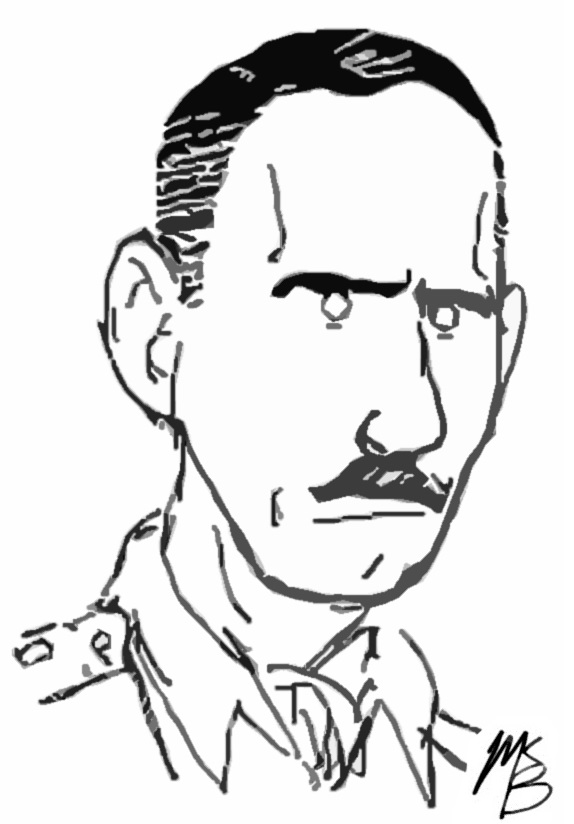
The Germans we are fighting are young, husky and well-trained, obstinate in defence but like all Germans, a frightened, screaming, panic-filled lot when routed from their holes and forced into the open …
News in the world is good. Italy has gone—irrevocably. How this breed fancied themselves world conquerors is beyond explanation.
(Forin letter to parents, in Vancouver Sun, 24 Aug 1943, 13)
Born in Nelson, British Columbia on 11 October 1900, John Douglas Forin was a Vancouver lawyer and graduate of Queen’s University and Columbia. A prewar member of the Seaforth Highlanders, he became second-in-command in England and took over temporarily in August 1942 after Lieutenant-Colonel J.M.S. Tait went home medically unfit. He passed command over to Lieutenant-Colonel Bert Hoffmeister in October and reverted to second-in-command.
Friends from before the war when they were on the same team with the Vancouver Rowing Club, Forin and Hoffmeister maintained a strong working rapport once the battalion went into action in Operation Husky in July 1943. The battalion chaplain remarked, “I doubt if any commander ever had a finer second in command—or if any second in command ever had a better colonel than Hoffmeister.”
With the closing of the Sicily campaign in late August, Forin took the time to update his parents on the battalion’s progress:
Time has gone quickly since we landed and much accomplished. We rested yesterday and are still at rest today, while other formations go forward. Presently we will pass through them and attack again. That is the wat of doing it—hitting first with one hand and then the other—“the old one-two” the troops call it, giving the Germans no rest …
Out officer casualties have been heavy but we have carried through every job laid down and gained some fine experience. One becomes fatalistic in these things, especially after seeing so many inexplicable incidents happen.
As the Seaforth pushed up the Italian peninsula, on 20 October 1943, Hoffmeister was promoted to 2nd Infantry Brigade in place of Brigadier Chris Vokes who was promoted to 1st Canadian Division. Forin became the new commanding officer of the Seaforth Highlanders.
Less than two months later, on 10 December, he was wounded by enemy artillery fire on his battalion headquarters outside of San Leonardo. “A high explosive landed right smack on the roof,” a captain who lost a leg in the attack explained. “I thought for a moment that all hell had burst loose over Italy in general and over my head in particular.” Forin returned to duty from North Africa two months later but was found medically unfit for active service.
A medical report stated “In his anxiety to get back to duty he coerced the hospital staff to let him return sooner than they thought wise and he has found that he has not got his usual energy. Fatigues more readily.” Declared unfit for active service, he was sent back to England, where he became acting commandant of a battle training school.
However, even on instruction duties he was not out of danger. He suffered a bullet wound to the abdomen during a nighttime live fire exercise on 8 July 1944. “The Brens were fixed on tripod and had been thoroughly tested before firing,” Forin reported after the incident. “I was walking along abreast of the line of students as they advanced; the overheard fire opened up and continued for a few minutes,” before a round fell short and struck him.
The same live fire exercise accidentally killed Major Robert Plumber Lyon of 48th Highlanders of Canada. Once Forin recovered, he was charged under Section 11 of the Army Act for neglecting to obey orders, resulting in the death of Lyon and injuries to himself and another officer, who would also be charged with negligence. In the September 1944 general court martial, defending officer, Lieutenant-Colonel R.C. Coleman objected to the framing of the charge as unfair to the accused:
Col. Forin is an officer of distinction and well known in the Army. I put a hypothetic case. Suppose the press reports this case. We feel if this was a legally framed charge without mention of the death of Major Lyon the Press could still report it ,and greater justice would be done to the accused. One can imagine the effect of unthinking persons reading this charge.
Coleman further speculated how a pension board might assess his wounds reading the charge sheet, “in the eyes of some person in the future who knew nothing whatsoever about the case.” Forin indicated he would be willing to plead guilty “if the charge sheet were properly framed,” but the judge advocate and court rejected the objection.
Forin’s exercise plan had included live rifle fire with a range of 1000 yards but Routine Order 4183 forbid overhead fire at a range greater than 500 yards. The order also stipulated that gunners needed to be able to see the troops under training. At that range and at night on the 8 July exercise, the gunners could not see the students on maneuverers. In his own defence, Forin testified:
I had come back from Italy in March and gone on the directing staff of the Senior Officers school. I was there for a month and during that time I had no opportunity of reading Routine Orders … I have thought of this a good deal, and it is a considered statement, if I had known of the existence of this Order I might have dammed it, but I would have seen it applied and this exercise would not have been held. I think that is all I have to say, I regret more than I can say that Major Lyon was killed.
The court found Forin guilty of violating the routine order but specified that this neglect did not directly result in the death of Major Lyon or the other injuries. Forin was thus released but reprimanded. When the case went before the judge advocate general for confirmation, the reviewing officer agreed that referring to the death and injuries in he charge sheet itself “was surplusage and might easily have resulted in an injustice to the accused.”
Forin went through a series of postings until assigned to a training battalion with the Canadian Reinforcement Unit in late 1944. When interviewed as to his future with the army, “He says he has always hoped, ever since his return from Italy, that he might again get command of an Inf. Bn in the field but he has now come to realise that this was never anything more than a pious hope.” At over forty, twice wounded over long service, he was simply unsuited for a field appointment.
The interviewer, Colonel F.J. Fleury, reported of Forin’s attitude, “This officer has not yet, I am sure, reached the point where he is feeling sorry for himself but he does hope that, when the present phase of intensive training within C.R.U. slows down, say in 3 or 4 months, he might have an opportunity to return to civil life.” Fleury concluded, “Normally, of course, Forin’s own wishes in this matter would be of relatively little consequence in determining our course of action. However, he has had a pretty rough ride, one way and another, and I must give him full marks for his motivation.”
After the war, Forin resumed his legal career and died in Vancouver on 6 August 1972.
 World War Graphic History
This was so interesting to read about my grandfather, John D. Forin. Thanks for writing this!
Thank you very much for reading and glad you enjoyed it!