Major-General Bert Hoffmeister
Seaforth Highlanders of Canada
2nd Infantry Brigade
5th Armoured Division
I’ll never forget one of my most embarrassing moments, having given my usual spiel, and having told them how important it was to keep right up close to the shell bursts, that the first shell bursts were all forward and there was absolutely no danger. In keeping up, you got to the German positions before they got their heads up, it reduced casualties and so on … when one round landed behind us. We were all flat on the ground, of course … but every soldier in that company looked around at me as if to say, “OK wise guy, what have you got to say about this?”
(Hoffmeister quoted in Delaney, The Soldiers’ General, 124)
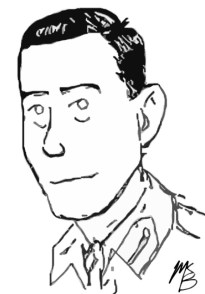
Widely regarded as Canada’s most successful and respected general in the Second World War, Bertram Meryl Hoffmeister commanded a battalion, a brigade, and a division from the landings at Sicily, through the Italian campaign until the final battles in Northwest Europe. Born in Vancouver on 15 May 1907, he was a lumber sales manager and member of the Seaforth Highlanders of Canada since 1927. He mobilized as a captain in September 1939 and three years later assumed command of the regiment he would lead into battle.
This rise to high command had not been inevitable, and early on Hoffmeister struggled with insecurities and doubts as a company commander while training in England. Confronted with the burdens of even small-unit level command, he later recalled, “I had a nervous breakdown. It was brought on by the anxiety of having responsibility for a hundred men … taking them into battle, and not having the necessary training to ensure I would do a satisfactory job.” He was hospitalized with conversion hysteria and anxiety in early 1941. When he recovered enough to return to duty he recognized that confidence came from knowledge and proficiency to which he committed all his efforts.
In the meantime, in July 1942, Lieutenant-Colonel J.M.S. Tait relinquished command of the Seaforths to Major J.D. Forin, who held the post until Hoffmeister returned from a training course in October. After months of training exercises, the Seaforths and their colonel experienced the first test of battle with the landings in Sicily on 10 July 1943. Having distinguished himself in the campaign, Hoffmeister was promoted to brigadier of the 2nd Infantry Brigade in October in place of Major-General Chris Vokes who took over 1st Canadian Division.
“Hoffmeister was a damn good battalion commander, a good disciplinarian,” Vokes later wrote of his subordinate. “He had good tactical sense, and he was earnest and serious. He seemed to have a grip on things and he ran his battalion in an outstanding fashion.” Less than six months later, in March 1944, Hoffmeister was promoted again to major-general of the 5th Canadian Armoured Division. After the fierce fighting in Liri Valley in May, he reflected on the cost of victory:
I had been around to visit the fellows who had bandages over their eyes, fellows who had been blown up in tanks, all of whom were convinced they were going to be blind forever, regardless of how much hope the doctors held out. They were terribly depressed as a group, so I just stayed with them and told them about the battle, how well the unit had done and how important it was, without which we couldn’t have won the whole thing.
(Quoted in Delaney, The Soldiers’ General, 152).
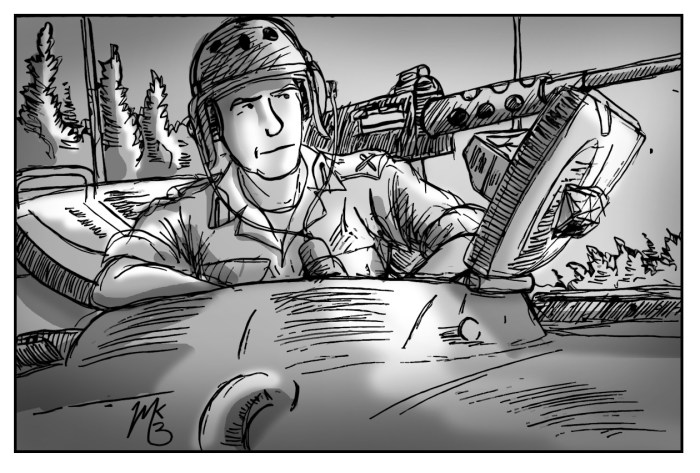
By March 1945, the 5th Division along with I Canadian Corps redeployed to Northwest Europe. After the victory in Europe, Hoffmeister was appointed to command the Canadian Pacific Force in the anticipated invasion of Japan. “They can’t be any more fanatical than some of the Germans’ elite troops,” he told the press on arrival home. “The Canadians had no trouble dealing with them—and we’ll have no more trouble dealing with the Japs.”
With the atomic bombing and the surrender of Japan, Hoffmeister’s war was finally at an end. Among many other decorations and awards, he had earned the Distinguished Service Order and Bar.
Following a successful international business career in British Columbia, he died on 4 December 1999.
 World War Graphic History