Lieutenant-Colonel David Rosser
Princess Patricia’s Canadian Light Infantry
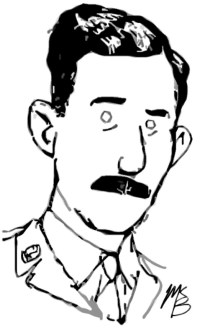
News that LCol David Rosser was now commanding officer came as a surprise. Assuredly he was qualified from a staff point of view to take command, but he had had little battle experience … He had never commanded a Patricia company in action, which to me and all other experienced officers was the litmus test for a prospective Commanding Officer.
(C. Sydney Frost, Once a Patricia, 272)
Born on 6 Dec 1905 Swansea, Wales, David Hillard Rosser was a Royal Welch Guards officer who immigrated to Quebec in the 1930s. With the outbreak of the Second World War, he volunteered with the PPCLI just before sailing for England in December 1939. Two years later he returned to Canada for a junior war staff college course at RMC. Following staff postings overseas, and promotions to captain then major, Rosser rejoined the PPCLI in Italy in March 1944, becoming second-in-command two months later.
By the end of June 1944, Lieutenant-Colonel Cameron Ware went on rest leave after eleven months hard fighting with the Princess Pats up the Italian peninsula through the Hitler Line. “I hate to have to tell you though that I am not commanding the Regiment any longer,” he wrote to regiment founder Hamilton Gault. “David Rosser has taken over and I’m sure that the Regiment is in good hands.” Promoted to lieutenant-colonel, Rosser continued the advance toward the Gothic Line.
The elevation of a recent arrival to command a battle-hardened regiment came as a disquietly surprise to Sydney Frost, who had joined the PPCLI as a lieutenant before the invasion of Sicily:
I had nothing against David Rosser personally, but I had severe reservations about a system that would allow an officer to become a Commanding Officer, or a Second-in-Command, without being given a real test in battle. It was unfair to the officer concerned, it was unfair to the officers who had been fighting with the Regiment for months, and above all it was unfair to the men who deserved the very best leadership available.
In early September 1944, Rosser fell ill with malaria only to be then wounded by shrapnel during shelling of battalion headquarters a few weeks later. After his evacuation, command passed to Major R.P. Clark, who had been with PPCLI since 1939. After the war, he then went to work for the United Nations Relief and Rehabilitation Administration in Yugoslavia. He then joined the British civil service and worked as trade commissioner for Nigeria in the 1950s.
Rosser died in Crawley, England on 20 May 1980.
 World War Graphic History