Lieutenant-Colonel Cammie Ware
Princess Patricia’s Canadian Light Infantry
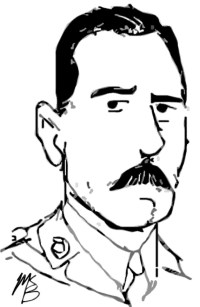
When you are a commanding officer, you are responsible for everything that happens in that Battalion and every man and so on … they are never out of your mind … You never get a night’s sleep … command entails everything … You’re responsible for every man in the Regiment … You’re responsible for every operation.
(Ware interview, quoted in Strickland, “Leading from the Front”)
Born 9 August 1913 in London, Ontario, Cameron Bethel Ware was son of a Canadian Army colonel and joined the PPCLI after graduation from RMC in 1935. Having been attached to the British Army for training just prior to the Second World War, he left England until Canada declared war only to return to England in October 1939. After completing infantry courses, Ware transferred back to the regiment in 1940 as a company commander. He became second-in-command of the PPCLI in February 1942.
En route to Sicily in July 1943, Ware and commanding officer Lieutenant-Colonel Bob Lindsay travelled on separate transports in case one should be torpedoed. As it turned out, the ship carrying Ware was struck and sunk. Although rescued, he and the survivors were held in a prisoner-of-war camp in Algiers to preserve the secrecy of the operation. He did not rejoin the regiment until after the landing in Sicily.
By the close of the Sicily campaign, on 9 August, Brigadier Chris Vokes replaced underperforming Lindsay with Ware. Promoted on his thirtieth birthday, he wrote to Hamilton Gault, the founder of the regiment: “I do not need to tell you all that the Regiment means to me … it is a proud day for anyone who gets command. The greatest privilege and honour that anyone could ever have.” Less than a month later, the PPCLI made the amphibious landing into Italy.
In the hard fighting up the Italian peninsula, Ware had several narrow escapes and earned the Distinguished Service Order for a nighttime raid. Over the coming months, he lost many more of his troops to injury and death. After the Battle of Ortona in December 1943, he wrote to Gault about the difficult conditions:
The fighting has been bitter and a different proposition from the early days of Italy and Sicily. The Hun’s stubborn and has lots of guts and skill. Have lost many fine men and officers but it’s been a grand show … They are so proud of being Patricias and I am so proud of them and I hate losing any of them.
The PPCLI suffered more terrible casualties through the campaign in Liri Valley in May 1944. His battalion headquarters came under shell fire and he witnessed men wounded and killed around him. Although he came out of the operation physically unharmed, the losses evidently weighed on his mind heavily. An officer later quoted him as saying “Those were fine boys. They are gone. I haven’t anybody left. They are all gone.”
Overstrained by eleven months continuous active service, he went on rest leave in July 1944 and was replaced by second-in-command Major David Rosser. “I hated to have to leave after all this year,” he confided to Gault, “although commanding a year in action is quite enough I guess.” He returned to England with the rank of colonel and took up training duties. As he explained decades later, “I was promoted to a cease-fire job in London with the old blandishments you’ll come back commanding a brigade.” Instead, Ware was appointed CO of 3rd Battalion, North Shore Regiment after VE-Day.
He continued his army career after the war, holding posts such as Canadian Military Mission to the Far East in Tokyo and director general of military training in Ottawa. He retired as a major general in 1966 and was honorary colonel of the PPCLI from 1959 to 1977.
He died on 21 January 1999.
For deeper analysis of Ware’s war service and leadership, see: Tod Strickland, “Leading from the Front: Lieutenant-Colonel Cameron “Cammie” Ware, DSO” in Intrepid Warriors: Perspectives on Canadian Military Leaders (2007) 199–221.
 World War Graphic History