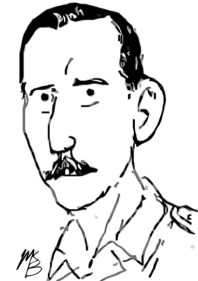
Lieutenant-Colonel Bob Lindsay
Princess Patricia’s Canadian Light Infantry
I felt they had missed an opportunity to deal the enemy a telling blow. There was no point in blaming the soldiers of the PPCLI. There were none better in the 2nd Brigade. I blamed Lindsay and the two company commanders for the cancellation of the operation without my permission and I made up my mind really to houseclean the regiment’s officers when the battle cooled. And I did.
(Vokes, My Story, 120)
Born on 12 September 1902 in Medicine Hat, Alberta, Robert Alexander Lindsay was a former lacrosse player, schoolteacher and principal. A militia officer in the South Alberta Regiment since 1927, he reverted from second-in-command to enlist with the PPCLI as a captain shortly before going overseas. He succeeded Lieutenant-Colonel Rod Keller on his promotion to brigadier in July 1941.
While Lindsay attended an officer course from October to November 1941, future brigadier Chris Vokes took temporary command of the PPCLI. Aside from this brief absence, Lindsay led the regiment for the next two years. During an inspection tour of the Canadian divisions in February 1942, General Bernard Montgomery had been impressed with the Patricia’s CO, regarding him as the best battalion commander in the 2nd Infantry Brigade.
During the Sicily campaign of summer 1943, Brigadier Vokes of the 2nd Brigade formed a very different opinion. On taking over the brigade a year earlier, Vokes recalled, “I left Lindsay in command of the Patricias which was a mistake.” Frustrated with the performance of the PPCLI in Sicily and after confusion over a cancelled assault, Vokes sacked Lindsay a month after landing on 9 August 1943. In his memoir, Vokes related an anecdote which perhaps revealed his own ideas about their incompatible temperaments.
[Lindsay] got on the blower. “We got sniped at,” he reported to me. We were near Modica. “And we caught three of them. What will I do with them?”
Compared to uniformed enemy combatants, Vokes regarded snipers in civilian clothes, “As far as I am concerned, they are to be considered criminals , murderers.”
“Use your head,” I told Lindsay. Our conversation was on the air, via radio. Anyone could hear. Lindsay came back again:
“What will I do with them?”
“Use your bloody head.” Lindsay kept repeating his question.
Finally I said, “Send them back. I’ll cope myself.” Back they came with a half platoon of Lindsay’s Patricias as escort … My idea was to shoot the three on the spot. As luck would have it, Simonds came along. I explained the circumstances. As senior officer present he would bear the responsibility for what happened and should, therefore, make the decision. “Fine. Go ahead. Shoot them,” he said.
Then Guy trotted off. But he was back in a minute. “No, you can’t shoot them!” …
I was not pleased with Lindsay.
(Vokes, My Story, 96-7)
Vokes, who claimed to have ordered the prisoners beaten, evidently viewed the incident as further evidence of Lindsay’s lack of ruthlessness and decisiveness. PPCLI veteran Sydney Frost, however, regarded the whole story as “crazy,” explaining in his own memoir:
As I read Vokes’ book, I could not believe (a) half the stories he told, and (b) that he or anyone else would put all this trash into print … I also feel sorry for Bob Lindsay who got such a raw deal. The great irony of the book is that while it denigrates Canada’s great general, it confirms beyond any doubt that LCol Lindsay was unjustly blamed and fired for postponing the attack on Mount Seggio. It is important to the memory of Bob Lindsay that the record, with the help of MGen Vokes, now be put straight.
Regardless of Vokes’ justifications, PPCLI second-in-command Major Cameron Ware took over and Lindsay went back to England. He later served the on staff with the Allied Military Government in Occupied Territories, and after the war, joined the Allied Control Commission in Germany for many years.
Returning to live in Canada in 1968, he died in Victoria, British Columbia on 26 June 1983.
 World War Graphic History
Thanks as always for this. I just read Frost’s description of Lindsay’s dismissal in Once A Patricia but I did not know about the appendices.
I can’t say that I am surprised by Vokes’ behavior.