Lieutenant-Colonel Lord Tweedsmuir
Hastings and Prince Edward Regiment
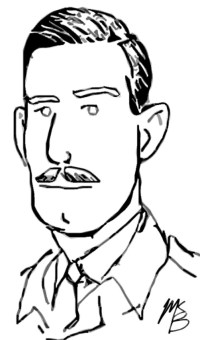
Barely thirty years of age, soft-spoken, kindly, with a slight tendency to stutter, he was a tall, fair-haired English romantic out of another age … his famous father’s perhaps. “Tweedie,” as we called him behind his back, had as a youth sought high adventure as a Hudson’s Bay Company trader in the Arctic, then as a rancher on the African veldt, and finally as a soldier in a Canadian infantry battalion. But until this hour real adventure in the grand tradition had eluded him.
(Farley Mowat, And No Birds Sang, 111)
Born in London, England on 25 November 1911, John Norman Stuart Buchan, 2nd Baron Tweedsmuir was son of the Governor General of Canada and the famous author John Buchan (1875–1940). Educated at Eton, he served in the colonial administration of Uganda before moving to Canada in 1936. Following a stint with the Hudson’s Bay Company in the far north, Buchan volunteered on mobilization in September 1939. He inherited his father’s title on 11 February 1940.
Lord Tweedsmuir served as second-in-command of the Hastings and Prince Edward Regiment in Sicily. When Lieutenant-Colonel Bruce Sutcliffe was killed suddenly on 20 July 1943, command passed to Tweedsmuir, who led the subsequent assault on Monte Assoro. He later described the siege: “As the shells shrieked into the tightly packed houses, it occurred to me to wonder whether this was the origin of the phrase ‘to paint the town red.’ Our guns pounded the town intermittently and a long night began.”
Four days later, on 25 July, Tweedsmuir was wounded and put out of action until the end of September. He resumed command for just over a month but fell sick and needed to be evacuated to North Africa in early November 1943. Major A.A. Kennedy, who had taken temporary command during Tweedsmuir’s first absence, assumed command of the regiment once again, having just escaped capture by the Germans.
Following service as a general staff and liaison officer, Tweedsmuir retired from the army in 1945 and took up his seat in the House of Lords. In one of his earliest speeches, he reflected on the postwar meaning of the British Empire:
This Empire has been through many moods; from the days in the beginning of the century and the atmosphere of the Golden Jubilee and Kipling verse on to the atmosphere of the Statute of Westminster, and to the years between the wars when a strange revulsion set in, and the word “empire” was everywhere spoken with sneers and abuse … The impression gained currency throughout the world that Britannia ruled the waves purely because she was prepared when necessary to waive the rules …
In this recent war, for the first time in our long history, we faced not defeat but complete racial extinction and the extinction of these institutions which were nurtured in this island and which flourish throughout the Empire to-day. Now, after six years we are worn and weary victors.
Still interested in science and adventure, Lord Tweedsmuir served as president of British Schools Exploring Society for over two decades. He retained his links to Canada as honorary colonel of the Hastings and Prince Edward Regiment from 1955 to 1965.
Tweedsmuir died in North Berwick, England on 20 June 1996
 World War Graphic History