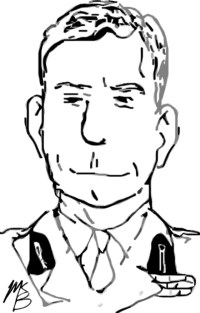
Brigadier Howard Graham
Hastings and Prince Edward Regiment
1st Infantry Brigade
I gave him a concise history of our relationship as being cold, critical, harsh, and unfriendly on his part, and he seemed to have little or no understanding or appreciation of the problems to be faced by a commander in the field. My brigade was excellent, there was none better, we had accomplished everything asked of us. I then told him of the tongue-lashing Simonds had given me in front of my driver and signaller after an all-night, difficult, but successful move.
(Graham, Citizen and Soldier, 163)
Born in on 15 July 1898 in Buffalo, New York, Howard Douglas Graham was a lawyer and long-time militia officer with the Hasty Ps. He had enlisted with the 155th Battalion in March 1916 before serving as an orderly clerk in England and with Canadian Corps headquarters in France. He graduated from Osgoode Hall in 1921 and was later commissioned with the newly formed Hastings and Prince Edward Regiment. He served a term as mayor of Trenton, Ontario in 1933.
By the call for mobilization in September 1939, Graham was second-in-command to Lieutenant-Colonel Sherman Young. Following a quick succession of three commanding officers over the next year, Graham took over in England in September 1940. Lieutenant Farley Mowat recalled, “It had always been his Regiment as far back as the 1920s, and now he devoted himself to maintaining the exacting standards that Salmon had set. During Graham’s tenure of command the unit attained its full pre-battle maturity.” After two years stationed in England, he was promoted to brigadier.
With this appointment for Graham to the 1st Infantry Brigade in September 1942, command of the Hasty Ps passed to Lieutenant-Colonel B.A. Sutcliffe. Both landed with the 1st Canadian Division in Sicily as part of Operation Husky ten months later. After an ugly dispute with Major-General Guy Simonds early in the campaign, Graham either threatened to resign or Simonds tried to fire him. Graham recalled telling General Bernard Montgomery of the British Eighth Army, “I simply cannot continue to command a brigade under such unfriendly and humiliating circumstances.”
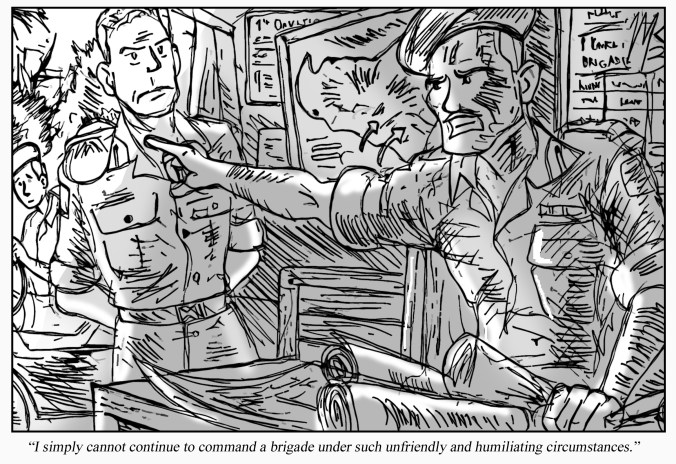
“This is a great pity. Graham is an excellent fellow and much beloved in his Bde.,” Monty observed. “I expect Simonds lost his temper. Simonds is a young and very inexperienced Divisional general, and has much to learn about command. He will upset his Division if he starts sacking Brigadiers like this.” After facilitating a reconciliation, Montgomery advised Simonds, “I want you to do the big thing and take Graham back.” He did and later recommended Graham for the D.S.O.
Troubled by stomach problems and ulcers after five months campaigning up the Italian peninsula, Graham relinquished the brigade shortly before the Battle of Ortona in December 1943. Simonds promoted Lieutenant-Colonel Dan Spry of the RCR to succeed him.
Reflecting on what he had witnessed across both conflicts, Graham remarked, “The second war was as different as the first war was from the bow and arrow days.” He stayed with the army after the war, rising to Chief of the General Staff of the Canadian Army from 1955 to 1958, in succession of Guy Simonds. Graham had started as a private, and through two world wars, ended as the country’s highest-ranking general officer.
Graham was head of the Toronto Stock Exchange in the 1960s and died in Oakville, Ontario on 28 September 1986.
 World War Graphic History