Major-General H.L.N. Salmon
Hastings and Prince Edward Regiment
7th Infantry Brigade
1st Canadian Division
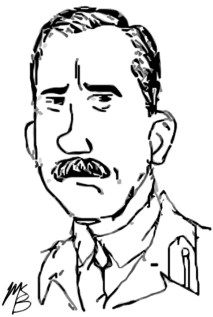
He was an outsider; Lt. Col. Harry Salmon, a Permanent Force soldier who might have been insulted by the order to take over a militia battalion. Certainly the regiment was grossly insulted by the appointment. Nevertheless, this man possessed the catalyst which was needed to transform the magnificent promise of the Regiment into reality. He knew the way, and he was ruthless.
(Farley Mowat, The Regiment, 74)
Born in Winnipeg on 9 February 1894, Harry Leonard Nowell Salmon fought in the trenches at the Somme and Courcelette, earning the Military Cross. He had enlisted with the 68th Battalion from Regina as a lieutenant in November 1915 and joined the 28th Battalion as a reinforcement officer in France in July 1916. Following a gunshot wound in September, he returned to the field just before Passchendaele.
After taking charge of company during an attack, Salmon received a M.C. Bar:
He was constantly up and down the line, encouraging and inspiring the men. Though twice buried by shell fire and badly shaken, he nevertheless continued his duties without assistance. His devotion to duty was most outstanding, and his courage and gallantry were of the highest order.
He was wounded again in August 1918 and ended the war as a major. Salmon stayed in the army after the war, served with the RCR in the 1920s, and attended the War Staff College at Camberley, England.
When fellow First World War veteran Lieutenant-Colonel Sherman Young relinquished command of the Hastings and Prince Edward Regiment due to health reasons in February 1940, Salmon took his place. According to Farley Mowat, the appointment of a Permanent Force officer to a rural militia battalion struck many officers and men as an unwanted professional army intrusion. The new CO immediately started to cull the ranks of all leaders he deemed ineffective. Mowat explained:
Heads rolled at once. There was cruelty in their treatment, but cruelty was needed. Hard as a headsman, and as implacable Salmon impressed his will upon the uniformed human material of the unit. Fear was one of his weapons, used deliberately. Officers and N.C.O.s hated him at first because they feared him, but they did what he said–either that or they were out.
Salmon led the battalion in France in the short-lived Second British Expedition Force of June 1940. He recalled to Canada in August 1940 to take up an appointment of general staff officer for 2nd Division. Major J.N. Edgar of the PPCLI took over the Hasty P’s until Major H.D. Graham, another First World War veteran and an original militia officer, took over in September 1940.
In June 1941, Salmon was promoted and succeeded Brigadier W.G. Colquhoun of the 7th Infantry Brigade as it prepared for movement to the United Kingdom. Commenting on the smartness of the battalions in his brigade, Salmon announced prior to embarking: “Everybody who served in the last war will bide by me when I say you could tell a good regt or a bad regt when things were going against us at the front.”
In September 1942, Andy McNaughton of the First Canadian Army promoted Salmon to replace the aging Major-General George Pearkes of the 1st Canadian Division. On 29 April 1943, just as the division prepared for the invasion of Sicily, Salmon died in a plane crash at RAF Chivenor in Devon, England. General Guy Simonds would lead the 1st Division, which included the Hastings and Prince Edward Regiment, in the invasion of July 1943.
One senior officer with the 4th Princess Louise Dragoon Guards captured the sentiment of many officers upon learning of the tragic death:
The news just came out on the radio today that Gen. Salmon has been killed in an air-crash. It is an awful blow to the Division as he was certainly the most efficient and thorough man that we have had. Don’t believe that anyone else has done as much for us as he has, or has personally worked as hard. He was a go-getter and damn nearly killed his own staff. He was not overly popular for this reason, but a damn good soldier.
In his memoir, The Regiment, Mowat likewise recalled that Hasty Ps would later recognize the necessity of Salmon’s firm hand:
The stories about him are legend. And now that he is gone, they have an affectionate overcast of memory about them. Grudgingly at first, but in the end wholeheartedly, the soldiers of those days gave him his due. He took the Regiment which other men had roughly sharped, and gave it fighting form.
 World War Graphic History