Lieutenant-Colonel Bill Mathers
Royal Canadian Regiment
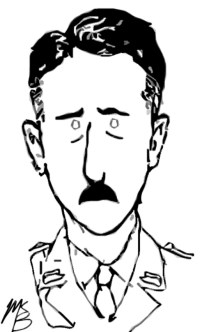
… when Bill Mathers got wounded an amusing situation developed. Mathers was standing out in the open pointing here and there as he gave out some orders. Sandy cautioned him about snipers, but he took no notice. All of sudden, Wham! and he got the slug through the upper right arm. Fortunately he had just turned on his heel at the time or he would probably have got it through the heart.
(Strome Galloway, Some Died at Ortona, 193)
Born in New Westminster, British Columbia on 11 October 1910, William Whelan Mathers was a University of British Columbia graduate and Permanent Force officer, commissioned with the RCR in 1936. He went overseas with the regiment in December 1939 but immediately transferred to staff and instructional duties in England. Having belonged to the Officers’ Training Corps at UBC, Mathers became chief instructor at the Officer Cadet Training Unit (OCTU) in Camp Bordon, Sussex.
He returned to Canada in March 1942 for further instructional work at the Canadian Army Training Centre in Listowell, Ontario. Although he had yet to see combat yet himself, he warned recruits, “The English have a slogan, ‘Sweat Saves Blood.’ You don’t want too many men killed in the initial stages of battle and that’s when most men are killed.” At a speech to a social club, Mathers explained, “We have been spared, thus far, the heavy losses that were experienced in the first two years of the last war, but our casualties are going to be terrible.”
In late 1942, Mathers became chief instructor at the Officer Training Centre (OTC) in Three Rivers, Quebec. As commandant in 1943, he posted daily maxims to encourage officer cadets such as:
The Officer’s golden rule … The men come first.
In War, those who don’t think fast—die! … so do the men they lead.
A poor officer says Go … A good Officer says Let’s Go.
In November 1943, Mathers finally had the chance to put his maxims into practice. He rejoined the RCR in Italy to replace Major T.M. Powers as second-in-command. Less than two weeks later, on 16 December, Lieutenant-Colonel Dan Spry was promoted to brigadier. Despite having no battle experience, Mather now found himself commanding the RCR on the eve of the Battle of Ortona.
Battalion chaplain Rusty Wilkes recalled of Mathers: “A small, precise man, he had definite ideas about how things should be done.” Eager and ambitious after spending three years training officers for the responsibilities he now held, Mathers attempted to make a firm impression on his arrival. He announced to the assembled troops, “Things are going to change in this regiment. No more slackness, no more slovenliness.” Given he had been in the field less than a month, his tone struck many as arrogant and bizarre, especially to those who had fought over five months in Sicily and Italy.
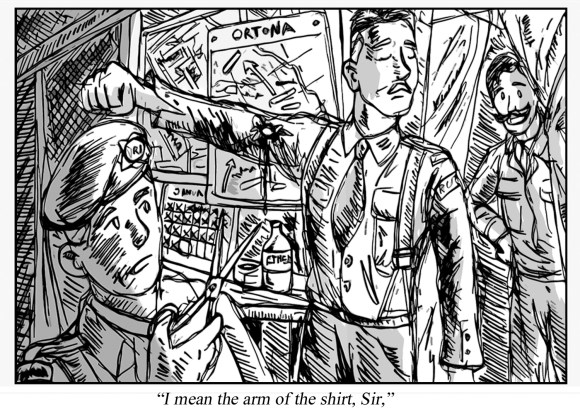
He made a poor first impression on several officers, particularly Captain Strome Galloway, who felt he had been passed over for promotion. When an enemy sniper struck Mathers in the right arm a day after taking command, Galloway related an anecdote that captured his low opinion of the new CO:
He got back behind the building and Sergeant Frank Mowers, M.M., of the Intelligence section, started applying first aid.
“I should cut the arm off, Sir,” said Mowers.
“Go ahead,” said Mathers heroically, bravely holding his arm up for such attention.
“I mean the arm of the shirt, Sir,” said the sergeant, “it’s a Viyella.”
Mathers, crestfallen, didn’t share the sergeant’s opinion. “Cut it off, cut it off,” he kept saying.”
“But it’s worth about seven bucks,” replied Mowers.
Finally, after several minutes Mowers acceded to the C.O.’s wishes and mumbling: “I sure hate to do this,” cut the shirtsleeve off and bandaged the wound. When I got there Mathers looked the heroic commander.
(Galloway, Some Died at Ortona, 193)
 While Mathers recovered, Galloway led the RCR until early January. Mathers returned but his uncompromising attitude continued to antagonize his subordinates. Chaplain Wilkes attempted to reassure one disrespected private, remarking, “Anyway, C.O.’s come and go, and maybe he won’t be here very long.”
After five months in command, on 1 June 1944, Mathers was replaced by Lieutenant-Colonel J.W. Ritchie, another Permanent Force officer from the rear echelon, to the frustration of Galloway. Mathers went on to command a reinforcement unit in Italy and by early 1946 was with the training centre at Aldershot, Nova Scotia.
He remained in the army after the war and by 1955 was general staff officer with the directorate of military training in Ottawa. Mathers headed civil defence in British Columbia in the 1960s. He died in London, England on 19 September 1972.
 World War Graphic History