Major Strome Galloway
Royal Canadian Regiment
By then, many more Royal Canadians had learned how to die; but fortunately many others, including myself, had learned how to live—or at least how to reduce the odds on dying. Sicily wasn’t all death in the sun, but it was an adventure for all. For me, it was my second campaign. Except for the CO, whose untimely death removed him from the scene 14 days after the landing, I was the only member of the battalion who had been in a battle.
(Strome Galloway, The General Who Never Was, 143)
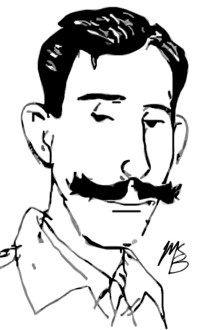
An exceptionally courageous infantry officer, a prolific and opinionated writer, and a stylish moustache aficionado, Andrew Strome Ayers Carmichael Galloway was perhaps the most interesting and colourful character in the Canadian Army during the Second World War. Born in Humboldt, Saskatchewan, on 29 November 1915, he was a prewar militiaman, amateur poet, and newspaper editor. Having joined the RCR just before the start of the war, he went overseas in December 1939.
In early 1943, Galloway along with several other Canadian officers were sent to North Africa to gain battlefield experience with British First Army. Attached to the 2nd Battalion, London Irish Regiment as a company commander, Galloway got his first taste of combat:
Playing at war as schoolboys, my friend and I often charged imaginary Germans with imaginary bayonets. On February 26, 1943, when I actually shouted “Fix Bayonets! Charge!” on the Tunisian battlefield our bayonets were steel, the Germans were real and the bayonet’s intended use was a wartime rarity.
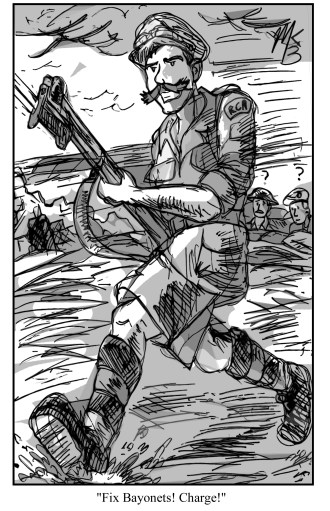 His archaic bayonet charge killed no Germans, but he and the 2nd London Irish found themselves in a firefight. After two months fighting in North Africa, he rejoined the RCR in May 1943. Another two months later, the regiment landed at Sicily in Operation Husky. Compared to Lieutenant-Colonel Ralph Crowe, who had been on a two-year exchange with the Indian Army on the Northwest frontier prior to the war, Galloway felt himself the most combat ready officer:
What [Crowe] had seen or heard, other than the crack of an occasional Waziri rifle, I don’t know. Certainly machine-guns, mortars, tanks and all the other lethal paraphernalia of modern war had been up until that memorable July 10 experienced by only one Royal Canadian and that one was me.
As a non-Permanent Force member of the RCR, Galloway was sensitive of his militia status compared to the regular officers chosen for command. Throughout his service he felt passed over for promotion and denied gallantry decorations. He had been unimpressed with Crowe, who was killed in action on 24 July 1943. Later he had more difficult relationships with Lieutenant-Colonels Bill Mathers and Jim Ritchie, two Permanent Force officers appointed to head the RCR with no battle experience.
When a sniper’s bullet wounded Mathers on his first day in command on 17 December 1943, Galloway became acting commanding officer. He led the RCR during the fiercest fighting at the Battle of Ortona until Mathers resumed command in early January 1944. While three different commanding officers came and went almost every six months, Galloway remained on duty for virtually the RCR’s entire war service from Italy to Northwest Europe.
He retired from the army as a lieutenant-colonel in 1969, became honorary lieutenant-colonel of the Governor-General’s Foot Guards, and in 1989 was appointed Colonel of the Royal Canadian Regiment. An opponent of armed forces unification and a royal traditionalist, he helped to form the Monarchist League of Canada in 1970. In 1972, he contested the riding of Ottawa–Carleton as a Progressive Conservative against Liberal John Turner. He lost by 9,000 votes.
In addition to his wartime diaries and many other books, he published his autobiography, The General Who Never Was in 1981, one of the classic Second World War Canadian memoirs.
Galloway died on 11 August 2004.
 World War Graphic History