Major-General Dan Spry
Royal Canadian Regiment
1st & 12th Infantry Brigades
3rd Canadian Division
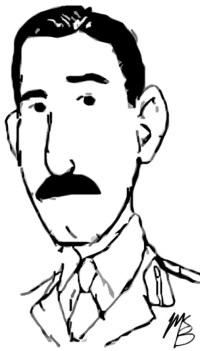
During the war, one of the big lessons I learned was that it was possible to bring together soldiers or sailors or airmen from every part of Canada, from every walk of life, every religion, every political viewpoint, and make them over into platoons, divisions, and corps, etc., and somehow or other, under proper leadership, they would fight as well as any other soldiers anywhere at any time. Perhaps we were all striving for something, some common objective.
(Maj-Gen. Spry to Boy Scouts’ Canadian General Council, June 1946)
Born in Winnipeg on 4 February 1913, Daniel Charles Spry was the son of a First World War colonel and the prewar army director of personnel. After dropping out of Dalhousie University, he followed his father in a Permanent Force career in 1933 and earned a commission in the RCR. On mobilization in September 1939, Spry was promoted captain and soon became the regimental adjutant. After two years in England, aside from the brief foray to France in June 1940, Spry left the RCR to the staff of 1st Canadian Division headquarters.
From September 1941 to August 1943, Spry served on various posts in England as a general staff officer. In the meantime, the RCR deployed to Sicily on 10 July 1943. After the deaths of Major Billy Pope and Lieutenant-Colonel Ralph Crowe one week apart, the battalion needed a new commanding officer. Spry, who was then serving as aide to General Andy McNaughton, received orders to proceeded to Sicily. He assumed command from Major T.M. Powers on 12 August.
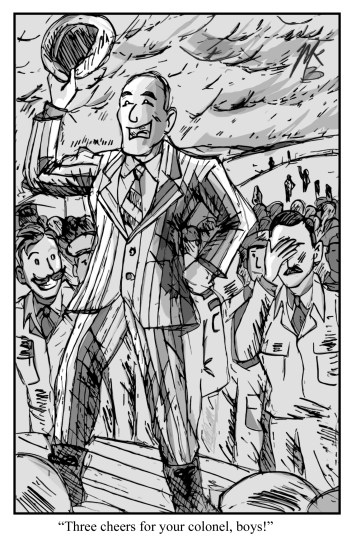
Nicknamed “Durable Dan,” Spry stressed regimental order and decorum, and at only thirty, impressed on the troops that they were men not “his boys.” On a speaking tour, Defence Minister James Ralston, First World War commander of the 85th Battalion, proceeded to break this etiquette calling for “Three cheers for your colonel, boys!” According to Captain Strome Galloway, “The Colonel’s face got more deeply red each time his views on the proprieties were transgressed … Even though he would never use the term himself, we became his ‘boys’ … until he went on to bigger things.”
 After four months leading the RCR through hard fighting up the Italian peninsula, Spry earned a promotion to take over the 1st Infantry Brigade from Howard Graham on 17 December 1943. Command of the RCR passed to Major W.W. Mathers, a recent arrival who was wounded by a sniper the next day. Major Galloway took over until Mathers recovered.
At the age of thirty-one, Spry was one of the youngest brigadiers in the Allied armies. Lieutenant Farley Mowat of the brigade staff wrote to his father, “our Brig is a masochist and so Bde HQ is under canvas in a muddy gulley out in the wide open countryside. I think he’s trying to prove that HQ is as tough and rough as the fighting troops. But who cares?” When Spry left for a new posting six month later, Mowat wrote, “the Brig in his farewell speech predicted I would some day write a book. He claims he likes my poetry … Personally I think this was why he didn’t take me with him to his new job.”
After ten months in Italy as a successful battalion commander and brigadier, in June 1944, Spry was assigned to organize the newly formed 12th Infantry Bridge in the 5th Armoured Division. However, two months later Spry transferred to the Normandy front to take over 3rd Canadian Division from Major-General Rod Keller who was wounded by American bombers in a friendly fire incident of 8 August.
With three rapid field promotions and another six months in a senior command, Spry was likely suffering from fatigue by March 1945. Unsatisfied with his recent performance, Lieutenant-General Guy Simonds of II Canadian Corps recommended his replacement. To avoid the stigma of removal, General Harry Crerar secured Spry’s transfer to command the Canadian Reinforcement Units in the United Kingdom.
Although Spry became vice-chief of the General Staff after the war, by the end of 1946 he retired from the army. Devoting himself to the boy scouting and veteran advocacy among other causes, he died in Ottawa on 2 April 1989.
For more on Spry’s wartime service and postwar career, see Gordon C. Case, “Wartime Lessons, Peacetime Actions: How Veterans Like Major-General Dan Spry Influenced Canadian Society After 1945,” University of Ottawa PhD dissertation, 2017. https://ruor.uottawa.ca/handle/10393/36186
 World War Graphic History