Lieutenant-Colonel Vern Hodson
Royal Canadian Regiment
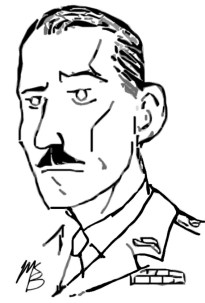
The RCR CO, Lieutenant-Colonel Vernon Hodson, hated the staff—he said Staff College was a “forcing ground for shits”—and believed that decorations or praise shouldn’t be offered. But the drunks and incompetents were soon weeded out.
(Granatstein interview with Gen. Robert Moncel, Weight of Command, 77)
Born in London, England on 16 September February 1884, Vernon Hodson had been first commissioned with the Connaught Rangers in 1905 before immigrating to Canada. He joined the Permanent Force in 1913, mobilized with the RCR in September 1914, and went to France in November 1915. He was soon promoted to captain then major. On 9 October 1916 at the Somme, a piece of shrapnel tore through his helmet and head, fracturing his skull.
After over a year in hospital and on home leave, he remained unfit for field service. A medical board in December 1917 recorded: “Still complains of headache, at times loss of memory and with great difficulty at times to concentrate. Seems slightly slow in responding to questions, and falters somewhat in speech.”
By July 1918, he was seconded to the Royal Air Force. After the war, he resumed his Permanent Force career with the RCR, eventually running through the regimental alphabet. He commanded “C” Company (London, Ontario) in 1928, “D” Company (St. John, Quebec), in 1931, “A” Company (Halifax) in 1937, and “B” Company (Toronto) in 1938.
He succeeded Lieutenant-Colonel K.M. Holloway in command of the RCR in November 1939 one month prior to the 1st Division departing for England. As part of the Second British Expeditionary Force, the 1st Canadian Infantry Brigade, comprising, the RCR, the 48th Highlanders, and the Hastings and Prince Edward Regiment, saw brief service in France in mid-June 1940. After the fall of Paris, the British and Canadian forces withdrew back across the Channel.
Nicknamed “Uncle Bill,” Hodson enjoyed considerable respect within the regiment. Major D.C. Spry, who later commanded the RCR in Italy, regarded him as “my idea of a regimental officer (Officer Commanding cum laude).” Hodson relinquished command in October 1940 when he temporarily took over the 1st Brigade. Interim command of the RCR passed to Major T.E.D’O. Snow, who was twenty-one years younger, before the arrival of the RCR prewar commanding officer, Lieutenant-Colonel Murray Greene. By January 1941, Hodson had been recalled to Canada with a promotion to brigadier of the 12th Infantry Brigade and later the 14th Brigade in the 6th Division.
Following postings with the Pacific Command, sixty-year-old Hodson retired from the army in 1944. He died in Grimsby, Ontario on 26 July 1945, just over one month before the formal end of the war.
 World War Graphic History