Lieutenant-Colonel Don Mackenzie
48th Highlanders of Canada
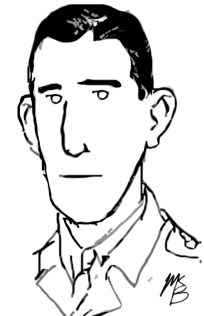
For extraordinary heroism in connection with military operations against an armed enemy on 12 April 1945 … Lieutenant Colonel Mackenzie, realizing that this was the turning point of the battle, went forward fearlessly in the face of heavy enemy fire to make a personal reconnaissance in preparation for the second phase of the attack. His plan of attack, based on the information he gained, was eminently successful, and his unsurpassed leadership and daring resulted in the complete rout of the enemy.
(D.S.C. citation, 27 Sept 1945)
Born in Kincardine, Ontario on 9 July 1914, Donald Alexander Mackenzie was a bank clerk and member of the 48th Highlanders since 1935. He was regimental transport officer during the battalion’s brief service in France in June 1940. He was soon promoted to captain then major and served as an aide to Lieutenant-General Bernard Montgomery in early 1942. He returned to Canada later that year for a staff officer course before being posted back to England for instructional duties in July 1943.
By January 1944, he had rejoined the 48th Highlanders as second-in-command in the Italian theatre. In June, He succeeded Lieutenant-Colonel Ian Johnston on his promotion to command the 11th Infantry Brigade. Mackenzie led the 48th in the remainder of the campaign through to the advance on the Gothic Line. The battalion redeployed to Northwest Europe in March 1945 and participated in the liberation of the Netherlands. At that a time he officially received the Distinguished Service Order for leadership Lamone River in December 1944:
The Commanding Officer, Lieutenant-Colonel Mackenzie, though still suffering from the effects of a severe case of jaundice, nevertheless came forward from ‘B’ Echelon to assume active command of the Battalion for this operation. Although pressed for time, owing to his recent arrival, he showed such an immediate grasp of the tactical situation and such energy and determination in reconnaissance, that he was able immediately to formulate a plan which, when put into execution, was a complete success.
On 12 April 1945, while attempting to re-establish communications via a field telephone in a Sherman tank, an enemy shell exploded nearby. Mackenzie was almost instantly killed. He was succeeded by second-in-command Major Jim Counsell, who would be the battalion’s final CO in the war.
Mackenzie posthumously received the Distinguished Service Order for leadership in Italy and the United States Distinguished Service Cross for “extraordinary heroism” in the action that led to his death.
 World War Graphic History