Brigadier J. Edwin Ganong
48th Highlanders of Canada
4th Infantry Brigade
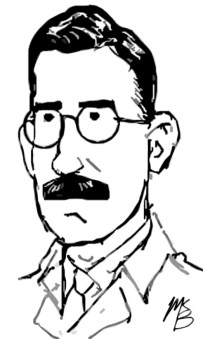
After we broke through Falaise, about D-plus 70, the Canadian soldier showed extraordinary fortitude and endurance. Troops seldom could be relieved; but they stood up under the most violent strain the war had produced. No matter how much training a man has, he is a novice until he is under fire. But the Canadians quickly became veterans. They were wonderful.
(Ganong quoted in Windsor Star, 22 Dec 1944, 9)
Born on 30 Dec 1903 in St. Stephen, New Brunswick, James Edwin Ganong Jr. was a Toronto lawyer who had attended the Royal Military College and Osgoode Hall. He was adjutant in the 48th Highlanders on mobilization and served as a company commander during the aborted Second British Expeditionary Force to France in June 1940. In March 1942, although he had already been promoted to the Canadian Corps headquarters staff, Ganong reverted to replace Lieutenant-Colonel Bill Hendrie.
In December, he was selected to attend a senior staff course and command of the 48th devolved to Major Ian S. Johnston. By May 1943, Ganong was serving as general staff officer with 4th (Armoured) Division under Major-General George Kitching.
The division landed in Normandy in early July 1944. When Brigadier Sherwood Lett was wounded at the end of the month, Ganong took over the 4th Infantry Brigade in the 2nd Canadian Division. That month, Canadians suffered severe casualties through the heavy fighting in Operations Totalize and Tractable to close the Falaise Gap. After less than two months in France, Lieutenant-General Guy Simonds of II Canadian Corps found the leadership of his subordinates lacking and determined to clean house.
Although General Crerar had warned Simonds about the “most deleterious general effect on the morale and cohesion of Canadian formations and units [from] frequent changes of command,” Kitching and Ganong were fired. By the end of August 1944, eight more brigadiers and fourteen battalion commanders had been replaced due to firing, wounding, or death. Ganong returned to Canada in December after five years overseas.
“The Canadians showed they had guts to burn,” he explained of the fighting in Normandy. “Nothing was too much for them. It was a continuous slugging match.” Praising the courage and abilities of Canadians troops, he also observed, “Generally speaking the Canadian soldier’s outlook has been broadened considerably. He has put away his narrow, local viewpoint and sees Canada as a nation among nations.”
When he returned to the United Kingdom in early 1945, he acted as chairman for No. 1 Officer Survey and Classification Board, which ironically recommended the retention or return of Canadian officers stationed overseas. After the war, Ganong was reappointed commanding officer of the 48th Highlanders, serving from October 1945 to July 1946.
He died in Toronto on 16 March 1970.
 World War Graphic History