Lieutenant-Colonel Bill Hendrie
48th Highlanders of Canada

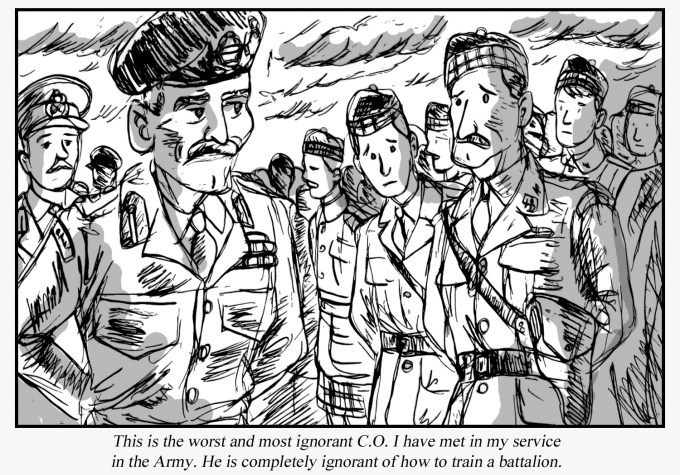
This is the worst and most ignorant C.O. I have met in my service in the Army. He is completely ignorant of how to train a battalion. He does not train his officers. He does not train his N.C.Os. His individual training is badly organized and men are bored with it; he admitted that this was so.
(Gen. Montgomery, “Notes on Inf. Bdes of Canadian Corps,” 3 Feb 1942)
Born in Hamilton on 6 March 1902, William Brown Hendrie was son of Colonel William Hendrie (1863—1924) who had commanded the 48th Highlanders from 1911 to 1913. He worked for the family transport business, Hendrie & Co., and had served with his father’s regiment since the 1920s. He was a company commander during the aborted Second British Expeditionary Force to France in June 1940. That November, he married Betty Scale (1916—2009), daughter of a British Army colonel, who he had met some months before while stationed in England.
On the promotion of Lieutenant-Colonel Bill Southam to brigadier in January 1942, Hendrie assumed command of the 48th Highlanders. Although reportedly popular within the battalion, he utterly failed to impress General Bernard Montgomery on his inspection tour of the Canadian brigades in February. In his report, Monty pronounced him the worst battalion commander in terms of training. One Canadian general felt “Hendrie was a gentleman but not a soldier.” He was replaced by Major Ed Ganong in March and sent back to Canada, where he was appointed to oversee airport defences in Vancouver and later acted as commandant of the Mountain Warfare School.
In November 1944, angry over orders that “Zombie” conscripts would be sent overseas, 1,500 troops from three battalions of the 15th Brigade staged a protest in Terence, British Columbia. As senior officer on the scene, Hendrie took charge of the initial response to this mutiny. He ordered his officers, “if there was any shooting to be done, to start with, I would do it.” Despite Hendrie’s suggestion to fly bombers over the camp in a show of force, the mutiny ended more peaceably.
He retired from the army at the end of the war and resumed his civilian business career. He died on 3 April 1975 and is buried in Hamilton.
 World War Graphic History