Brigadier Bill Southam
48th Highlanders of Canada
6th Infantry Brigade

His voice was exceedingly cheerful throughout … There wasn’t a quiver in it and occasionally he would make some wisecrack. He was the same old boy through it all. We kept in contact with the brigadier all the time and between 1 and 2 o’clock he sent a message saying he could see some troops surrounded and out of ammunition down the beach and they were surrendering.
(Quoted in The Province, 24 Aug 1942, 22)
Born in Toronto on 11 September 1901, William Wallace Southam was a graduate of RMC and grandson of prominent Canadian newspaper publisher William Southam. He joined the family business as vice-president and managing director. Having belonged to the 48th Highlanders since 1922, he became second-in-command of the 1st Battalion on mobilization in September 1939. He participated in the aborted Second British Expeditionary Force to France, which ended in the battalion making a desperate escape by train in June 1940.
On the promotion of Lieutenant-Colonel Eric Haldenby to brigadier in September 1940, Southam assumed command of the battalion in the United Kingdom. In January 1942, Southam was promoted again to command 6th Infantry Brigade, 2nd Canadian Division, which would take part in the Dieppe Raid eight months later. Command of the 48th passed to Major William B. Hendrie.
On 19 August 1942, Southam landed on Dieppe beach under heavy enemy fire. “All right, boys,” he was heard to remark, “here we go. We’ll see this thing through,” just before a shell struck his landing craft. He pressed forward and tried to establish a brigade headquarters on shore. As the plan fell apart and troops tried to evacuate from the beach, Southam observed “there was no sign of fear or panic—they seemed to be stunned—and almost incapable of action.”
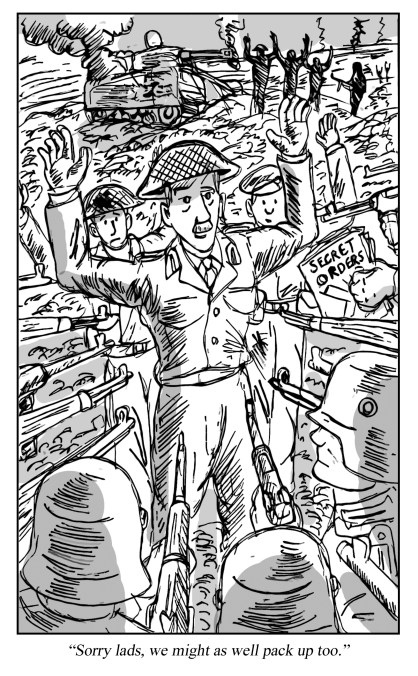 The trapped Canadians were soon overwhelmed and surrendered to the Germans. “Sorry lads,” he told his aides, “we might as well pack up too.” Southam was one of nearly 2,000 prisoners-of-war taken and the highest-ranking officer captured in the aborted raid. He failed to destroy the secret attack plans before the Germans seized the documents, which described orders to shackle German prisoners. In retaliation, Germans chained the Canadian prisoners from Dieppe leading to further escalation and retaliation from Britain against enemy POWs.
Although now confined in Germany, Southam was awarded the Distinguished Service Order in absentia. He spent the next thirty-two months in a prison camp, until liberated by the U.S. Third Army in April 1945.
He died in Toronto on 1 April 1950 at the age only of 49.
 World War Graphic History