Lieutenant-Colonel Henry Weldon
2nd Bn., Leinster Regiment (Royal Canadians)
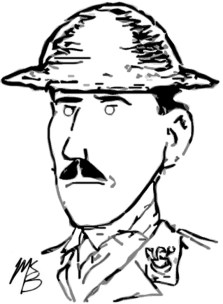
The Regiment has unfortunately lost some most valuable officers … all of whom had done splendid work, which would have brought recognition had they been fortunate enough to survive.
(Weldon to Maj. Gen. Prior in Whitton, The History of the Prince of Wales’s Leinster Regiment, vol. 2, 174)
Born in Dublin on 2 November 1878, Henry Walter Weldon was commissioned a lieutenant in 1900 and served in South Africa. He was adjutant for the 1st Leinsters and temporarily took command after Second Ypres following the death of Lieutenant-Colonel C. Conyers on 12 May 1915. He served with the battalion now under the command of Lieutenant-Colonel J.D. Mather on the Salonika front in 1916.
By June 1917, Weldon was back in Ireland and attended the funeral of his brother, Colonel A.A. Weldon, former commanding officer of the 4th (Extra Reserve) Leinster Regiment. Follow a brief posting to the 2nd Battalion, Worcestershire Regiment in late December, he assumed command of the 2nd Leinsters on 12 January 1918. Lieutenant-Colonel A.D. Murphy had been killed two months earlier and the acting C.O., Major J.R. Frend, now reverted to second-in-command.
On 21 March 1918, Weldon was temporarily commanding the 47th Brigade when the German Spring Offensive began. After his headquarters was shelled, he organized a withdrawal on 23 March until the brigadier arrived. Weldon resumed command of the 2nd Leinsters, but in the confusion of the rapid enemy advance he became separated from the unit. When attempting to chronicle the muddled events, regimental historian F.E. Whitton admitted:
But if the story is badly presented, at least let the difficulties of the historian be recognized, The Germans broke through the British line; there was a thick fog; immense numerical superiority prevailed; the Fifth Army suffered the greatest reverse in the history of British arms; confusion inevitable but immense, reigned everywhere; the 2nd Battalion was practically wiped out, and almost every officer was killed or wounded. These circumstances do not make for exact accuracy of narrative.
By 1 April 1918, Weldon was back in command but needed to rebuild the shattered battalion. The 19th Entrenching Battalion, which had been formed from the 7th Leinsters two months earlier, provided some reinforcements. Aside from medical leave, Weldon remained in command through to the end of the war. By the armistice, he was one of a handful of regular officers still on active service in the regiment.
In 1923, he was appointed to command the 2nd Battalion, Bedfordshire and Hertfordshire Regiment. He died while stationed at Bagdad on 2 June 1925.
.
 World War Graphic History