Lieutenant-Colonel G.A.M. Buckley
7th Bn., Leinster Regiment (Royal Canadians)
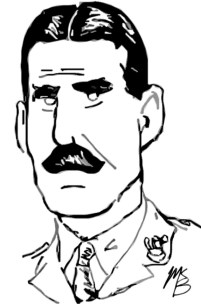
We are not yet out of the wood, let us see to it that at the eleventh hour nothing is done to detract from the high honour that has come to us. I appeal to you once again–officers and men let us pull ourselves together for the last lap … As for me, my heart has bled for you all during these days and nights of trial. I shall thank God when I see you all safely out, and there is no prouder colonel in the whole British Army than I am to-day.
(Lt. Col. Buckley, 5 Aug 1917 in Whwiitton, The History of the Prince of Wales’s Leinster Regiment, vol. 2, 428)
Born on 25 October 1866 in Christchurch, New Zealand George Alexander McLean Buckley was a sheep farmer, land broker, county politician, sportsman, swimmer, polo player, model yacht enthusiast, explorer, and soldier. He joined the British Army in 1885 and served in India before returning to New Zealand in 1891 to manage the large Lagmhor Estate. Noted for his many interests and adventurous spirit, he travelled to Patagonia in 1897 and joined partway Ernest Shackleton’s 1907 expedition to Antarctica. By the outbreak of the Great War, he had been living in England for ten years and took up soldiering once again.
In February 1915, he was appointed commanding officer of the recently raised 7th Battalion, Leinster Regiment, which he led to France in December as part of the 47th Brigade, 16th (Irish) Division. The bouts of illness that had prevented his participation in the Boer War caused Buckley’s extended absence in October 1916. During this sick leave, command devolved to Major H.W. Gaye, and later Lieutenant-Colonel T.R.A. Stannus.
Buckley returned to the field in May 1917, but because the 7th Leinsters were preparing for imminent action against Messines Ridge, he suggested Stannus retain command for the operation. “The spirit that prompted the suggestion,” regimental historian F.E. Whitton observed, “was typical of the sportsmanship of Colonel Buckley.” Stannus was severely wounded when a shell hit battalion headquarters. He died ten days later on 17 June. Buckley had reassumed command on 9 June 1917.
Of the changes to the battalion over the colonel’s eight-month absence, Whitton stated:
Few of the present officers and men had served under him, but that attractive personality which all who knew and served with him so freely acknowledged soon overcame all reserve, and he was very soon the “Father” of one of the happiest “families” in France.
Buckley’s leadership carried the 7th Leinsters through the coming months, but his health broke down again, and was invalided to England in January 1918. Just over a month later, the battalion was broken up to form the 19th Entrenching Battalion under the command of Lieutenant-Colonel J.D. Mather.
After the war, Buckley returned to his active outdoor lifestyle and bought an island on the coast of Scotland. He died in London on 10 November 1937.
 World War Graphic History