Lieutenant-Colonel J. Craske
6th Bn., Leinster Regiment (Royal Canadians)
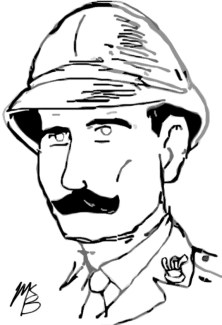
“When I am sniped, I always sit down,” and did so—still in the open, while the remainder wasted little time in taking advantage of some convenient rocks. More sniping—then a volley of oaths from Craske whose staccato imprecation “Mygod, mygod. Damnfellowsgotme. Damnitall. Damnitall,” was characteristic. Fortunately the wound was a slight one in the left arm.
(Whwhiitton, The History of the Prince of Wales’s Leinster Regiment, vol. 2, 334)
Born in Somerset, England on 7 November 1869, John Craske was commissioned with the Leinster Regiment in 1890 and fought in the Boer War, for which he received the Distinguished Service Order. Unlike many officers of the “Royal Canadians,” he had a personal connection to the Dominion. In 1899, he married Grace Oliver of Halifax, Nova Scotia, daughter of William Silver Oliver, former Canadian deputy surgeon general.
In August 1914, as part of Lord Kitchener’s New Army, the Leinster Regiment formed a new service battalion. As the regimental depot commander, Craske was appointed commanding officer of the 6th Leinsters. Over the coming months, he oversaw recruiting and training for the new battalion until it was ready to deploy the next summer.
As part of the 29th Brigade, 10th (Irish) Division, the 6th Leinsters arrived to Gallipoli in early August 1915. They were almost immediately thrown into action in the failed landing at Sulva Bay. The battalion managed to repulse a Turkish counterassault but lost several junior officers and Craske suffered a gunshot wound to his arm on 10 August. He relinquished command to Major R.G.T. Currey, who was subsequently succeeded by Major J.C. Colquhoun in September.
Craske did not resume command for nearly a year until July 1916. By that time the 6th Leinsters had moved to the Salonika front, and by the end of the year, the 1st Leinster Battalion had joined them in the 29th Brigade. As part of the 10th Division, the brigade redeployed to Egypt in September 1917 to join the Sinai and Palestine campaign.
As described above, Craske was slight wounded by a sniper on 6 December 1917. During several periods in 1917/18, he served as acting commander of 29th Brigade, with several different majors briefly taking command of the battalion. The 6th Leinsters left the Near East for France in May 1918. By September, the unit had been disbanded, with some troops reinforcing the depleted 2nd Leinsters on the Western Front.
Craske ended the war with a C.M.G. and died on 1 June 1936 in Cork, Ireland.
 World War Graphic History