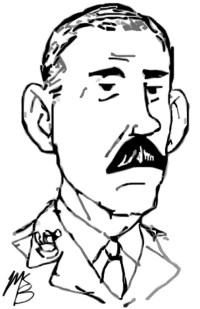
Lieutenant-Colonel E.F. Farrell
5th Bn., Leinster Regiment (Royal Canadians)
PATRICK WHITE asked the Secretary of State for War whether he will state the name of the commanding officer of the 5th Battalion Leinster Regiment, formerly the Meath Militia; whether he is aware that on the annual training of the men instructions were issued on their separating that they were not to join the Irish Volunteers, and that anyone so doing would be dealt with by the military authorities; whether such threats were issued with the sanction of the military authorities; and what instructions, if any, have been issued to officers with regard to their attitude towards men who wish to join the Irish Volunteers?
(Hansard, Vol. 65, 20 July 1914)
Born in Dublin on 1 January 1863, Edward Francis Jenico Joseph Farrell and his family had deep connections with the Leinster Regiment. In 1886, he had been commissioned in the 5th Battalion, also known as the Royal Meaths from its pre-1881 militia identity. Four of his nephews also served with the regiment during the Great War. On the eve of the war, with tensions over Home Rule in Ulster threatening civil war in Ireland, Nationalist MP Patrick White, alleged that Farrell had threatened his reservists to not join the Irish Volunteers. Prime Minister Asquith replied, “the statement is wholly incorrect and that he has issued no such instructions.”
The outbreak of the war postponed the Unionist/Nationalist conflict, but some reserve officers felt the crisis affected mobilization plans for Ireland. While many expected that the 4th and 5th (Extra Reserve) Battalions would go into battle led by their own officers, both militia units remained stationed in Ireland to provide reinforcements. In the words of regimental historian, F.E. Whitton, the 3rd, 4th, and 5th Leinsters, “had perforce to undertake the honourable but less showy duty of training drafts and sending them overseas.”
As commanding officer of the 5th, Farrell would likely have been too unwell for active service in any case. He fell seriously ill with pneumonia in mid-August 1914 and would not recover until the end of the year. Command passed to Major E.J. Jameson, who would be killed in action leading the 1/4th Battalion, Essex Regiment on 27 March 1917 in the Battle of Gaza.
In January 1916, Farrell went on an instructional tour of the Western Front. During the Easter Rising four months later, the 5th Leinsters engaged insurgents in Dublin, with one soldier killed. Commander-in-Chief of Ireland, Sir John Maxwell, praised the loyalty of the Irish regiments: “without any sign of flinching or wavering, … had lived up to the high reputation which their battalions had made in France.”
By December 1916, Farrell had retired from recurring ill health and command of the 5th passed to Major John McDonnell. After the 5th was disbanded in May 1918, McDonnell was attached to the 1st Battalion, Royal Inniskilling Fusiliers. He was killed in Ypres on 29 September 1918.
Farrell died in County Meath, Ireland on 1 Jan 1951.
For more about the Farrell family’s part in the Great War see: https://greatwaroldgal.com/2021/01/16/rabbit-hole/
.
 World War Graphic History
Pingback: The Royal Canadians | World War Graphic History