Lieutenant-Colonel A.A. Weldon
4th Bn., Leinster Regiment (Royal Canadians)
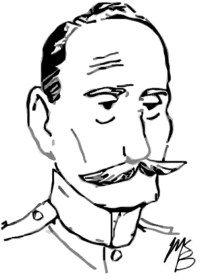
I think myself, the later rebellion ill judged and ill advised as it was, has opened the eyes of the people to the dangers of carrying arms which should never have been allowed … At the same time, I think out of ill may come some good as some measure of local government will be devised with the wish of the whole country which will bring peace to this unhappy country in the future.
(Lt. Col. A.A. Weldon in Freeman’s Journal, 3 August 1916, 6)
Born on 1 March 1863 in London, Sir Anthony Arthur Weldon, had been commissioned in the Leinster Regiment in 1885 and served in the Natal Field Force during the Boer War. He was aide-de-camp to Commander-in-Chief of the Forces Lord Wolseley from 1895 to 1900. On the death of his father in January 1900, Weldon became the 6th Barnonet of Dunmore. Since 1908, he was commanding officer of the 4th Leinsters.
Despite his connections and appeals, Weldon was disappointed to learn in late 1914 that his battalion had been designated a reserve unit and would not serve in action. His younger brother, Henry Walter Weldon, fought as a major with the 1st Leinsters and commanded the 2nd Leinsters in 1918.
On 14 April 1916, the 3rd (Extra Reserve) Battalion arrived in Limerick. Ten days later Irish republicans revolted against British rule and proclaimed a republic. While heavy fighting took place in Dublin, Weldon worked to secure Limerick. He negotiated with several hundred Irish Volunteers, who eventually peacefully surrendered their arms after the uprising in Dublin failed. The local Irish nationalist leader, Michael Colivet, credited Weldon for his tact and even-handedness in bringing the tensions to a bloodless conclusion.
Weldon had toured the front in December 1915 and visited the 7th Leinster in the trenches in January 1917. A few months after returning his health broke down and command of the 4th Leinisters passed to Lieutenant-Colonel T.E. Willington. Ill from frontline conditions and still under stress from the Easter Rising, Weldon suffered a stroke from which he did not recover.
He died in a Dublin hospital on 29 June 1917.
.
 World War Graphic History