Lieutenant-Colonel A. Canning
3rd Bn., Leinster Regiment (Royal Canadians)
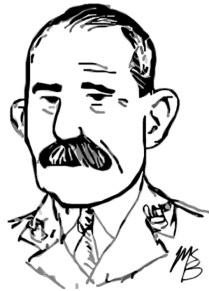
His departure was sorely regretted by all ranks, for during the twelve months he had been with the 7th, his capabilities as a commander had only been surpassed by his solicitude for the men’s welfare, so that he had made his way into out hearts as a popular soldier.
(Capt. S.J. Wilson, The Seventh Manchesters: July 1916 to March 1919, 4)
Born on 3 October 1861 in Wiltshire, England, Albert Canning was a veteran of the Anglo-Egyptian War (1882) and the Sudan campaign (1884-5). He had joined the ranks of the 19th Hussars in 1881, received a commission in the South Wales Borders in 1888, became a captain with the Leinster Regiment in 1895 and retired as a major in 1911. He came out of retirement on the outbreak of the Great War to take command of the 3rd (Special Reserve) Battalion.
As part of his responsibilities to train Leinster troops for the front, he expressed frustration that the reserves continued to be used in guard and fatigue duties. Arguing that unfit men could be better employed for noncombat labour, Canning stated: “the training of the Special Reservist as carried out at the annual trainings is insufficient and on mobilization he was handicapped for the work in front of him by carrying out fatigue duties when fighting was imminent.”
Although stationed in Cork, he took an active interest in conditions in the field to ensure his training program sufficiently prepared inexperienced troops for modern warfare. He asked officers leading drafts to the front to “report fully whether the training received in the 3rd Battalion stood the test of war.” Major H.W. Weldon, temporarily in command of the 1st Leinsters after Second Ypres paid “special credit” to the training that reinforcements had received in the reserve battalions.
Canning soon got his own chance to experience the test of war firsthand. In June 1915, he was posted to the Dardennelles and assumed command of 1/7th Battalion, Manchester Regiment. In his absence command of the 3rd Leinsters passed to Lieutenant-Colonel W.B. Reed.
According to Canning’s second-in-command with the Manchesters: “We could have had no greater confidence in any possible Commanding Officer, and while he acted as Brigadier of the Manchester Territorials his influence was no less inspiring. The record of our later campaign on Gallipoli is closely associated with his name and work.”
After nearly a year in the field, the fifty-four year old Canning went on sick leave back to England. He soon resumed command of the 3rd (Reserve) Leinisters for another two years. After an extension of duty, he was finally relieved in August 1918. He became a justice of the peace in Wiltshire, England and volunteered for the Home Guard during the Second World War.
Although Canning was one of the oldest colonels in the Leinster Regiment at the start of the First World War, he also lived the longest. He died in Wiltshire on 20 November 1960 at the age of ninety-nine. He had also been the oldest surviving veteran of the Anglo-Egyptian War, seventy-eight years earlier.
.
 World War Graphic History