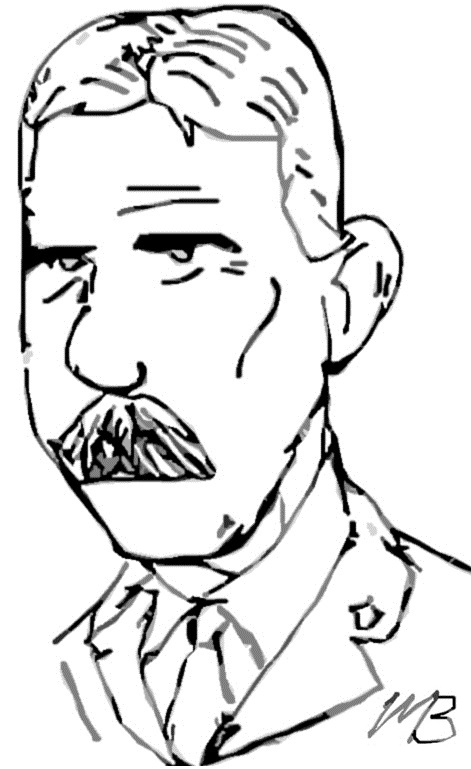
Lieutenant Colonel A. G. F. MacDonald
154th (The Counties’ Own) Battalion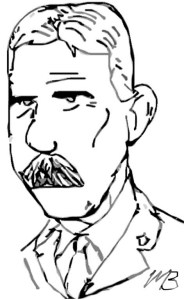
So Cheer Up is our motto; Downhearted, No!
And we will soon be on our way.
We live in hopes to lick them soon.
And be home again some day.(154th Bn. Postcard, 1916)
Alexander George Fraser MacDonald was a journalist and editor born in Alexandria, Canada West, on 24 August 1863. He was the son of Donald Alexander Macdonald (1817—1896), a Liberal MP of Glengarry and fourth Lieutenant Governor of Ontario (1875—1880). The younger Macdonald had founded the Glengarry Weekly News in 1893 and joined the militia in 1896. By the outbreak of the Great War, he was commanding officer of the 59th Regiment.
MacDonald raised the 154th Battalion, based in Cornwall, from the counties of Stormont, Dundas and Glengarry in spring 1916. At the presentation of the battalion colours in August, the colonel called on his men to “live up to the traditions of their ancestors, the stalwart U.E. Loyalists and never let the old flag fall.” The 154th sailed for England in October 1916 to provide reinforcements for the field.
When his second son, Lieutenant George Fraser Macdonald, died fighting at the Somme on 18 November 1916, the Glengarry News published a tribute and reprinted the son’s final letter to his mother:
I know that I have been neglecting, you for the last two weeks or so, but i they have been very strenuous ones for us, and it is only now after some days rest that I have got the energy necessary for writing …
However Mother dear from now on if i can’t manage at least one letter a week, I am going to mail you a Field Post Card every day or so. (We call them whizz-bangs out here after one of Fritz’s well known shells.) It must have been awfully hard on you to pan with dear old Father and Hubert. You certainly are doing your bit and you do not know how much I admire your pluck. I am wondering if the 154th has really sailed or whether they are still in Canada, as I have received no word from England.
Going in and out of the trenches is a regular picnic, between getting stuck in the mud and slipping into shell-holes, and some of the language heard on occasions would certainly be unprintable, though there is almost cause for it sometimes. It is wonderful to see the difference in all of us an hour after we arrive at Billets. All the way in we grouch and grumble and look to be the most disgusted crowd on earth, but a hot meal and a wash (after two or three days without one) and you, would not know the men.
P.S. — What’s the use of worrying? If there are any good snaps taken any time send me a copy for my pocketbook, especially of you dear.
(Glengarry News, 1 Dec 1916, 1)
After learning a Lieutenant MacDonald had been killed under his command, Brigadier W.S. Hughes wrote A.G.F. MacDonald:
Surely it cannot be that he was your son–a very bright, cheerful character and a true brave soldier. He was shot be an enemy machine gun in the face and heart. The poor boy did not know what hit him. We had his body brought back and buried today … If this dear boy should be yours, you have my heartfelt sympathy and will you please tell his mother for me that he was all that a good true brave officer should be and that his men loved him very dearly. I wish he ahd told me who he was and I assure you I would gladly have done anything I could for him … I know what it means to those of us who have our boys in the awful war, and again wish to assure you of my sincere and heartfelt sympathy in your loss.
(Glengarry News, 29 Dec 1916, 1)
Although too old for active service, the fifty-three year old MacDonald went on a brief tour of the trenches and saw his son’s grave. He returned home in July 1917. During the Second World War, another son, Sergeant Ian Bruce MacDonald of the Stormont, Dundas & Glengarry Highlanders died in England in May 1944.
MacDonald retired from the Glengarry News in 1944 and passed the editor position to his other son. He died in Cartierville, Quebec on 24 June 1948.
 World War Graphic History
Can anyone shed light on the correct spelling of Alexander George Fraser’s last name, ie, is it Macdonald or MacDonald? I’m in procession of a photocopy copy of an Attestation Paper dated January 20, 1916 in which his signature clearly shows a spelling using a lower case letter D.